Showing posts with label Special places. Show all posts

Monday, December 7, 2020

Dusk and dust

Blaentillery Drift Mine

Above the town of Blaenavon at the head of the Afon Llwyd valley is a disused drift mine on the flank of Coity Mountain. The road which once serviced it remains a conspicuous contour on the hillside - though not in the way of a scar, for it has blended well into the moorland, offering the prospect of a gentle if longish climb to the now dilapidated works.

I went there the other week, my third visit in as many months. It's a melancholy place - occupying those seductive edges of past and present, industry and nature, that tempt us to attribute it with meaning, when in fact, there is only what is there. 

It's beautiful nonetheless. The skeleton of the old shed silhouettes against the sky, rusted beams tone with the autumn bracken and violet horizon of the Black Mountains to the north. Even the graffiti seems apposite - adding a kingfisher flash to an otherwise limited palette. 

When I showed some photos to a friend, he asked me, 'Have you ever seen Hinterland?' referring to the noir detective series that's filmed in Mid Wales. It's set in a landscape that evokes something of a cross between the old testament and frontier homesteads. The original Welsh language version was titled Y Gwyll, which means 'the dusk' - that time between twilight and darkness; the opposite of dawn.  

I had to look the translation up, and at first misread it, thinking - until checking a few days later - that 'gwyll' meant 'dust'.  How pertinent for writerly purposes that link would have been: nature reclaiming its own, steel leaching rust to the earth, the walls of the pithead crumbling... and the coal in the lungs of the miners...

You see, how easy it is to impute meaning.

I guess I could do the same with dusk - weave a narrative about the twilight of mining, reference the Big Pit Museum, the shadows of the men who worked these seams...  It turns out that the drift on Coity Mountain - known as Blaentillery - was actually the last in the area to close, opening in the Sixties and struggling on till early this century. 

I often wonder about the prospects for the South Wales Valleys. Ultimately, these are communities whose purpose has gone. Years ago they would have decayed like the mine; today we won't -  can't bring ourselves - to allow that to happen. And so they struggle on too, occupying an indeterminate ground, lacking the skills and infrastructure to remodel their future, yet too rent by the past for a transition to tourism. 

And hence the melancholy - which it's all too easy for outsiders like me to romanticise when that gift (if that's the right word) is hardly mine to bestow. If there's any meaning in place it lies not in the landscape in and of itself,  but in our relationships to it. Those who lived and worked here would no doubt have a different - and truer - perspective than three visits in as many months can hope to conjure. 

But that's as it should be. For whenever I walk the tops of these hills I sense that despite knowing them for half my life, their valleys will always be something apart. I look down to the ribbon rows of houses not so much with sadness, as curiosity - even a little envy. And ironically, I remember that the reason I first came here, was they reminded me of home.


Tuesday, May 28, 2019

Special places - The Boat Yard Tea Room

The brilliant Boat Yard Tea Room at Pontymoile 

It's strange the places that we like the most; that bring a smile to the face whenever they're mentioned; that we love for their familiarity more than any prospect of the new...

Since returning to South Wales four years ago, I reckon the spot which has given me most joy, is a tiny little cafe, housed in a land-locked barge on the edge of the canal at Pontypool. It's at the Pontymoile Marina near the southern end of town and one of those locations that estate agents might chance as 'semi-rural'. When we were there last week, I told Jane it was my favourite place to eat, and wouldn't swap it for any of the gastro-pubs that are ten-a-penny in Gwent.

She's heard all this before. I give her the same spiel every time we come, which is about once a week and more often if I get a chance. Thankfully, Jane likes it there too, and has long since given up suggesting I change the record or widen my horizons. As I wiped the last crumbs of eggy bread from my plate I muttered something about it being the best cafe in South Wales and possibly my favourite of all time...

Which is unashamedly true.

It's ironic, that living in area renowned for pubs and restaurants, I increasingly dislike visiting all but a few. Most times there's an inverse relationship between how much a place is lauded and how much I enjoy the experience. It doesn't help that I don't drink, but it's more than that: they cost too much, they're inauthentic and they leave me cold.

Unlike at Pontymoile.  Where, usually, we take a walk on the tow path to work up an appetite, reminding ourselves that in less than a mile we're in the national park, and wondering why more people don't take advantage. In truth, it's busier at weekends but on an average Tuesday we seldom  pass more than a handful of ramblers on the way to our turn at bridge number fifty nine... Then it's back at a spritely pace for two eggs on toast, two slices of bacon and a cup of tea please - twice.

That all comes to around a tenner, and it's served with welcoming smiles and a chat about where we've been and who's doing what. Jane reckons I'm a different person at the cafe - that few people get to know as much about me as do Kelly and her dad James who run this little gem of a place.  But then they're as much a part of why I visit as the menu.

On the subject of which, don't expect any fancy-pants bistro fare. All day breakfasts are the staple, with hot drinks, hand made cakes and often a daily special, which might be home made soup, or perhaps bubble and squeak... you get the idea. And so do lots of others - on a sunny Saturday the customers spill onto outdoor tables and we've learned to order in advance as a sell-out isn't unknown.

But as I said, it's not really about the food - or at least, nothing you'll find on the menu - because what they really serve here, is something that's hard to write down and even harder to price.  I'd call it 'care' - and the whole place reeks of it! From the hearty food to the bright decor, to the thoughtful attention to their local community (we like to have cheap treats for the kids, says Kel) - it's as tangible and in your face as the smell of their sausages on a winter's morning.

And without a doubt, that's why I like this place so much.

In a world of that's full of bland shops, bland restaurants and even blander service - this place is real and alive and full of character. Sure, there's a hint of nostalgia in my liking it so much - of times and facilities we've lost - but why not, and why not celebrate and support what's still there.  Kelly and James are making a go of a small business that's a little different - and a lot better - than any amount of branding could ever deliver.

So it's sad to hear that the marina is due to be redeveloped, with plans for a visitor centre putting  their tearoom under threat.  And how ironic that by making the place so popular they've put their own future in doubt - not that you'd sense it - only last week they held a free afternoon tea for their customers.  If the revamp goes ahead I hope the trust licences any new facility to Kelly and James - they've earned that chance.  But more than that, if they don't, they'll lose something special very special indeed.

Visit while you still can:  The Boat Yard Tea Room at Pontymoile Marina

Thursday, March 7, 2019

Refuge de Bostan

Westering sun from the Refuge de Bostan  (photo Antonia Chapple)

The questions I’m most often asked about visiting a mountain refuge are entirely predictable. Firstly, there are those who enquire about facilities: can you book a private room; are there flush toilets; do they sell alcohol?  And then there are those who want to know the route, the date and whether they might come along too. Other than an occasional query about the food (usually from veggies) the two enquiries seldom overlap.

I suspect the schism, between caution and enthusiasm, has always been this way.

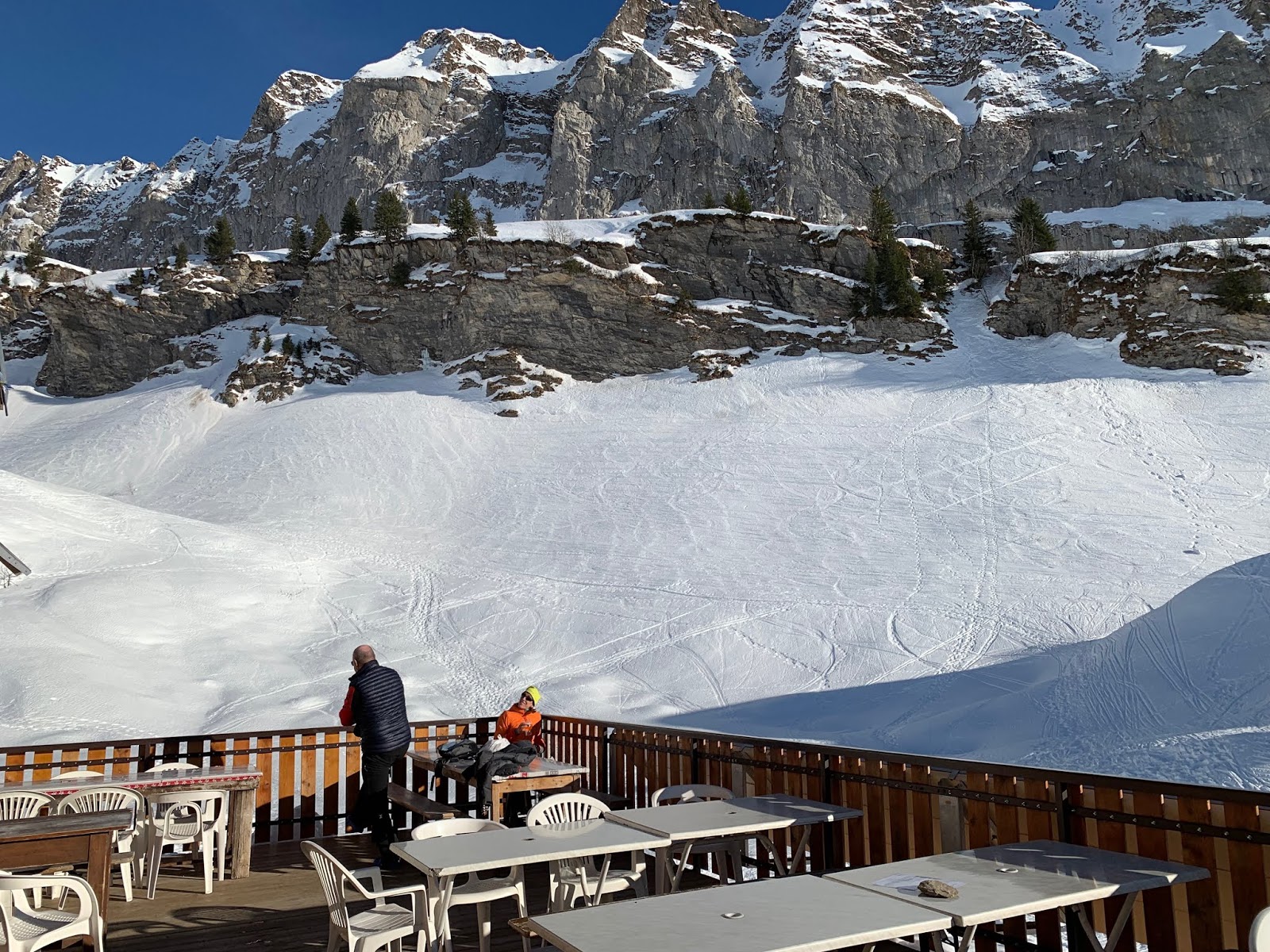
Last week, along with family and friends, I climbed to the refuge de Bostan, above Samoens in the Haute Savoie.  It’s on the GR5 trail so is popular with trekkers in the summer, but also one of the few refuges in the region to open in winter. A visit is often combined with an ascent of the Tete de Bostan; however, on this occasion our ambitions were more focused on camaraderie than challenge.

The most popular route starts in the hamlet of Allemands, from an improbable car park at the upper limit of the snow clearance. It takes a well-marked trail through the Foret de Bostan, before emerging onto open slopes and passing two isolated chalets, from which the way ahead is equally obvious.

Frankly, there’s not a great deal more to say on the route finding; we climbed under cobalt skies but it would be hard to get lost here in all except a white out. The gradient is steady; snowshoes help but are not strictly necessary, the skiers found it easy; all in all, it’s about as stress free as it gets in winter.

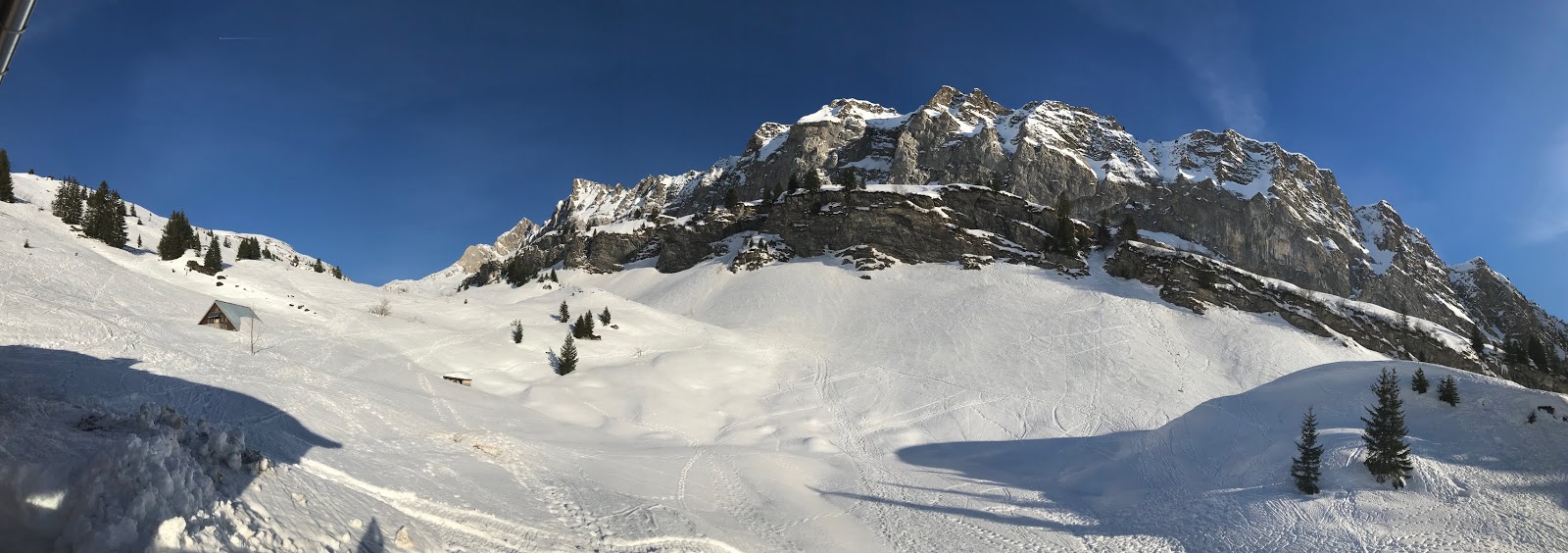
But don’t for one moment equate difficulty with interest. To the north, the gentler slopes of the Pass de Golese steepen to the Bostan ridge; opposite, the north face of the Dent’ d’Oddaz casts a gelid shadow on the tightening valley. As we walked the final meters to the refuge an eagle soared above us, momentarily spooking the choughs that were foraging for scraps.

The refuge itself is aesthetically unremarkable, though all things here are relative; at 6,000 feet in a sublime alpine landscape I marvel at who built it; the sheer efforts they must have gone to. There’s a large deck on which we order some refreshments, drinking in the view and waiting the arrival of our second party, who’ve taken a route from the Valley de la Manche to the north.


They arrive smiling, and fourteen of us spend the next two hours chatting, marvelling and air-dropping photos.  We sit and watch the snow redden as the sun dips to the west, the lengthening shadows giving form to icy couloirs, Taking their leave in a tangerine sky, the last of the coughs bicker and wheel on their way to the forest below.


Inside, the refuge has refectory tables, a small bar and a few sofas.  There’s a wood burner, a sink with limited water and few Buddhist prayer flags by way of decoration. It’s Spartan and yet homely enough. Upstairs the dormitories have rows of mattresses, clean duvets and pale lighting to guide in the passages. I opt for a bottom bunk, reckoning it's easier if I need to make the 2.00am hike to the outside loo.

I guess I could tell you more about the meal we had (veggies catered for), the composting toilets or the breakfast next morning – I might even clarify that it costs 45 euros for demi-pension (less for children).  But would any of that be reason to go, or for that matter to give it a miss?

For what’s important – and what will surely stay with us all – is that we laughed and drank and (some of us) snored through the night in an elemental place that’s worth infinitely more than any supposed discomfort.  And I’d defy anyone who’d made the effort not to feel something of the same.

As we walked out the next morning, snowshoes crunching on the frost, I recalled my first night in a refuge. It was forty years ago at the Dresdner Hutte in the Austrian Stubai; the only information we had was three lines in a mountaineering guidebook. It’s still there and yes, you can book a room, there are flush toilets and alcohol is served. The views at 7,500ft are magical, and it's a good base for climbing the Osstlicher Daunkogel too - but if you were more attentive to the facilities than the location, I’d suggest you keep to the valley.


Sunday, June 11, 2017

Land of my fathers

Russell's Cairn on the summit of Windy Gyle.

Next winter, it will be three decades since I came to Wales; more than half my life, and a long time more than the 'two or three years' I'd planned to stay. I love it here and suspect it's where I'll see out my time. But the true land of my fathers is Northumbria, at the edge of England, where the sky is sharper, and the sun rises over the sea.

I wrote recently of the backpacking trips I made as a student. That was in the early Eighties, around the time I became closer to my maternal grandfather. He too loved the outdoors, and though in his seventies, came with me on many trips to the mountains. I remember in the summer of 1981, climbing the Simonside Hills on the morning of the Royal Wedding, where we met a group of similarly lost souls, looking for somewhere to escape the madness. And I remember too, around the time I returned from university, me showing him the route to Windy Gyle.

Last week I was there again; this time with my son Daniel. He's just finished his degree and wanted to talk about his plans. I suggested we go to the hills but chose the route without any conscious nostalgia. For all that, it never fails to surprise me, how our histories have a habit of repeating themselves - as we set off, I packed my bag with the same OS map I'd used thirty-five years before.

The walk begins about as far into the Cheviots as you can reach by road. To get there, you must first pass the Rose and Thistle at Alwinton, where Sir Walter Scott wrote Rob Roy. There were cyclists heading our way, waving us through as we drove by the banks of the upper Coquet. It was warm for early morning, only thin trails in the sky; the deepening valley stirring memories of times that that had shaped me, and yet lain dormant for years.


Not everything is the same as it was: there's now a car park at Barrow Burn and new information signs from the National Park - but otherwise, this place feels timeless. Our route follows the drover's road to the border fence, briefly joins the Pennine Way, ascending to Russell's Cairn on the summit. Like much of the Cheviots the path is soft underfoot, the climbs more rounded than steep; a view that relies on the changing light to give form to its barren beauty.

We reach the cairn in less than two hours and drink greedily from our flasks. My thirst reminds Daniel of a trip ten years earlier, when we had walked together along the Preseli ridge back home in Wales - it was he who stumbled on the hidden stream that allowed us to camp by the bluestones at Carn Menyn.  The story of that journey - and how it helped me see Daniel anew - became the opening chapter of my book, Counting Steps.

You're not going to write about this as well, he asks?

We returned down the valley past Row Hope farm, drinking our fill from the clear water springs. There were skylarks above us, small heath butterflies in the dun grass, and two ravens patrolling the slopes to our left. I check the map and the words on the battered paper invoke a subconscious smile: Headless Clough, Mosie Law, Rough Knowe, Black Braes...  These are names and language of the northern fells; a lexicon that was once as familiar to me as the Celtic equivalent of where I live now.


But I sense there was more to my involuntary smile than a recalled familiarity. The landscape of our childhood - or more particularly, the place where we 'come of age' - has a profound hold on our sense of self. I'm sure that's why so often we define ourselves in relation to where we were born; why so many of us, despite our peripatetic lifestyles, seek to return 'home' in later years; and why, on the occasions that we do, we feel a depth of belonging that transcends the here and now, connecting our presence to the past, and even to lost generations.  As I've got older, I've come to realise, that what in Wales they call Hiraeth, is not unique to the Welsh.

Ironically, my own father did not like the hills, preferring the town, or at a push, the sea. But in fairness, he too stayed resolutely a man of his place. One of his few questions, when I visited before he died, was to ask how it had felt to cross the River Tyne - true Geordies cry, he'd said.  I lied, (though not with intent), telling him that home meant nothing to me now - I'd moved away and wouldn't be coming back.

If only life, and the paths we take, were that simple.


Thursday, March 23, 2017

Reflection and adventure - at the Refuge de Chavanes


Twenty years ago (a little more actually), on plane from Nepal, I had a fleeting encounter that has lodged with me ever since. After kayaking the Kali Gandaki River I was flying home with amoebic dysentery as a souvenir – next to me sat a Nepalese businessman, who in making conversation was curious as to why I should visit a country that could make me so ill?

I remember explaining that Nepal was special, the mountains higher and the rivers more remote than could ever be found in Wales. ‘Then go to the Alps’ he replied, ‘you can have just as grand adventures there!'

I recalled this conversation last week, high in the mountains of the Haute Chablais, as the ridges of the Pointe de Chalune blushed crimson in the embers of the light. That afternoon, a group of us had skied and snow-shoed from the Vallee du Brevon to the remote Chavanes refuge. It sits in the shadow of a glacial cirque, to the south of Les Gets, about an hour from Geneva.

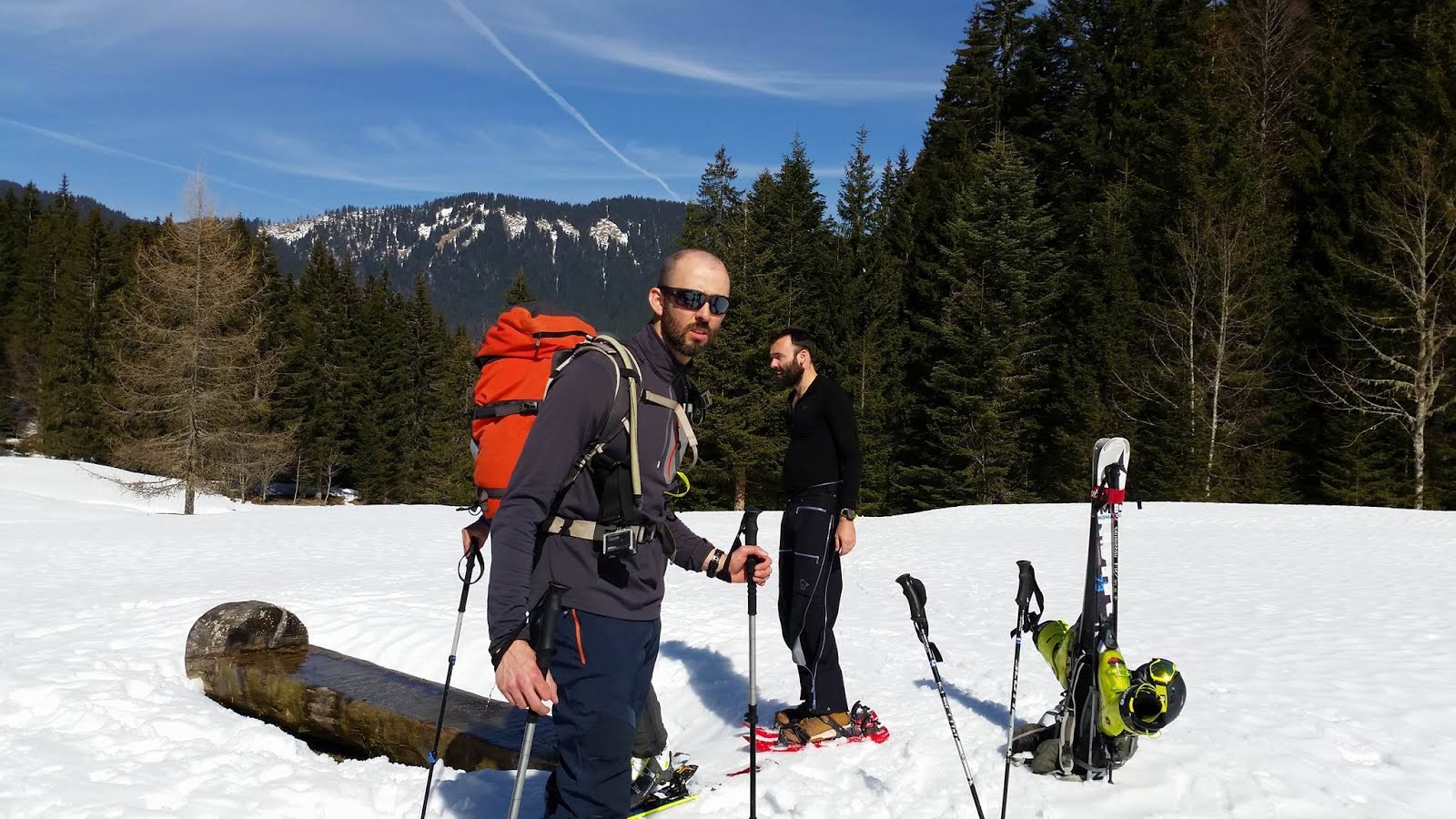
I’d not worn snowshoes before. In a sense, that was an adventure in itself: adjust the heel, strap in toes, check for grip as the baskets flex... At first, I’m glad of my poles, but soon I’m into my stride, scanning for crossbills as we pass beneath pines that are laden with cones. There are tiny spiders scurrying between the fallen needles, and I try to avoid them by shoeing in the rutted snow.

An hour later, we reach an isolated chalet. There is running water and an improbable earth closet for passers by, though the prospect of undressing persuades me it’s easier to pee around the back. We gobble cheese and salami as Simon, who’s been here before (and is ex-navy so can’t help but command), gives us a briefing: it’s steeper from here, there’s ice on the track; be careful towards the top.

Some in the party are using skis, attaching ‘skins’ that resist backward slippage when the ground gets steeper. It looks an odd way to travel, and all the more so in the knowledge of the lifts and gondolas on the other side of the valley. Eddie tells me it’s like fell walking, only with on planks on your feet - he explains that it might look hard work, but there’s a deep satisfaction in making the summit under effort.   As he talked, I remembered the last time I climbed Snowdon; the contrast between the walkers on the summit, and the crowds, making a beeline to the café from the Llanberis train.  

My snowshoes grip well on the steeper ground, they have integral crampons that bite into the ice, and a ‘heel raiser’ which takes pressure of the calves. Though I start in the lead, the others gradually pass me. A year with a dodgy knee has added considerably to my ‘pack’, but overall, I reckon I’m not going too badly for an old man. Leanne, who looks as though she could skin up in half the time, kindly stays to keep me company. She too has travelled widely, but talks eloquently of her love for the Alps, and desire to keep on returning.

Eventually, the trees give way to more open ground, and the final pull is less steep than I’d feared – the others have waited at the rise. We’re in a ring of granite and ice, cradling a bowl of trackless snow; above us are the peaks of the Chavannais, the Chavasse, Chalune and Haute Pointe  Nobody is saying very much.

At the refuge we meet a walking party from Thonon les Bains; they are leaving after what seems to have been a fine lunch. The refuge is owned and manned by Claudius, who, in his visitor books, is variously described as a ‘sage’ and ‘mountain gourmand’.


So perhaps unsurprisingly, we are welcomed with mouse de cider and wine laced with hazelnut syrup. At night he serves us prunes in bacon, followed by chicory salad, pain de campagne, beef bourguignon, a cheese board the size of which I’ve not seen before… and some apricot cake to finish.

And then, there were the wines.

They began with a liqueur de prune, followed by a homemade apricot, some sapin and cassis, and, of course, a little genepi to finish… At one point I counted nine bottles on the table, but it was getting hard to focus.

I’ve been visiting mountain refuges for more than thirty years and the Chavanes is certainly on the rustic side, but its food and ambience are among the best I’ve discovered. The company was a delight too, reminding me that for all I occasionally dream otherwise, I prefer the warmth of friends to the solitude of journeys made alone.

Which, in a roundabout sort of way, brings me back to the man on the plane from Nepal. I long ago came to the conclusion that he was right. I’ve been exploring wild places for all of my adult life, and am fortunate to have easy access to the Alps – but the truth is, we don’t need to go very far, or always to be alone, to find adventure.

The Valley de Brevon is a stone’s throw from the Portes de Soleil, and yet, a million miles from the après ski of Morzine. I could show you places that are much the same in Wales, The Lakes, or Northumberland. Only last month the definitive Scottish Bothy Bible was published – there’s enough inspiration in its pages for a lifetime.


The next morning (after breakfast by Claudius) we descended to the bustle of the valley, and I reflected on the simple, life-affirming, trip we had made together. The Chavanes refuge is, to use an expression coined by the Himalayan explorer Mo Antoine, as wild and as wonderful, as I need to ‘feed my rat’. He meant, by that, to ‘scratch the itch’, to sate his quest for adventure. 

I understand what he meant, and feel privileged to have done something of the same.

Saturday, January 11, 2014

After the storm


Near to my house is the beautiful cove of Abereiddy. The picture above is a stock shot from the Internet - it was probably taken about ten years ago, but that doesn't matter - the important thing is the line of the sea wall and where it joins the headland.

Compare this to the picture I took this morning.


To be fair the sea walls were removed a couple of year ago and the car park has receded a few meters each winter - but the recent storms did the equivalent of ten years' work in a night.  There was room for five cars today!

To the south is Newgale, a mile of sands backed with a bank of cobbles. The picture below was taken at Christmas.


The same spot this morning...


It's common for the winter storms to lower the sand, but in twenty years I've never seen it so denuded. A little further down, the petrified trunks of an ancient forest have been exposed for the first time in decades.

Above the usual shoreline, the putative defence is being replaced after the tide had brushed it aside.


And yet today all was calm, as beautiful and wondrous as ever - in some ways more so.


Saturday, July 6, 2013

Shed of the year


I see that a hand-built cabin in the Cambrian Mountains has won Cuprinol's Shed of the Year. A prize of £1000 attracted hundreds of entrants - and about a million quid's worth of free publicity for Cuprinol. I bet their marketing team is delighted.

It seems that sheds are all the rage. There are books on sheds, brochures on sheds, TV programmes on sheds; there's even the equivalent of 'shed porn' websites (not really you understand)  on which enthusiasts download images and arrange shed parties or whatever else they do. I'd bet there's been academic papers with titles like 'the itinerant shed and its role in a post-modern society'.


Depending on your definition, I have at least two sheds and possibly three. The difficulty comes in whether our outhouse is truly a shed or just a room for the boiler. But let's not get all philosophic  - for the purposes of this blog we can agree that I have two, and I'll declare my working definition as being that a shed should have room to sit, read book and make a cup of tea. The ideal one would also have a sofa or bed, capable of accommodating at least a mid afternoon snooze.


In my case, the attraction is part nostalgic. My grandfather had a gimcrack cabin he would retire to after his daily trip to the Legion. It smelled of beer and leeks and had net curtains and a tripod table with a lace tablecloth. The walls were covered in our childhood drawings which in some cases he'd framed, though he was as good as blind.

There's also a need for space - 'thinking' a much as 'physical' - which some would argue is a reflection of our homes and lifestyles. But in fact, the idea of a creative haven has a long tradition, as well as practical application in so far as it allows for materials to be readily available and projects easily returned too.  My recent playing of the saxophone gives this a new twist - I'm regularly banished to give the family some peace, rather than the other way round!

I've often wondered about the benefit of installing sheds at the office - it's an attractive idea, but doomed to failure. In no time they'd be demarcated; there'd be rules and regulations, an on-line booking system, plasma screens and tea and coffee on demand - they'd be a pastiche of the real thing, a veneer for the ego; out of touch with the original purpose.

Not that there is some deep meaning or meta-purpose in the sheds themselves - that too would be bollocks. They are simply a means to fun, to reconnecting, to winding down, to time alone - or in my case, to time with Dylan - twice this week we've had a 'shed-night': watched a movie, had some snacks, read stories and woken up to the dawn chorus - precious times. What's that phrase... can never come again?


But if times can't come again; ideas are constantly recycled. I couldn't help noticing the shed of the year's resemblance to the upturned boats on Lindisfarne. They have been there, icons of time and place, for more than a century - the oldest dates from 1902. Believe it or not, they're now in the care of the National Trust - so much for the humble cabin.

And not a drop of Cuprinol in sight.

Sunday, October 7, 2012

Why exactly are we doing this...?


It was raining - hard as it happens -  the traffic crawling and a snake of tail lights extending somewhere towards Birmingham. The kids were moaning in the back; the ipad was out of charge and the crisps weren't the right sort. Driving 300 miles up the M6 on a Friday night is not the time or place to be impatient...

Jane snapped, Remind me again, why exactly are we doing this?

Five hours later we reached Preston and our bed for the night at a Premier Inn.  If we get up at six, I jollied, we could reach the Lakes in a couple of hours, have breakfast in Keswick... Jane's look suggested I keep schtum.

But it's strange how moods can turn. The room was spotless, the pub next door just what we needed, and Dylan slept through the night without a murmur.  Next morning we were off (at eight-thirty), driving to Penrith under a cobalt sky and debating how we might lengthen the walk in.

Our goal was Black Sail Hut, one of the oldest youth hostels in the UK and certainly, the most remote.  It's situated in the Ennerdale Valley and requires a five mile trek from almost any direction. Travelling with us was a friend and her two children (aged 6 and 7) - which explains why our sacks were bulging with sweets and chocolate as we strolled the south shore of Buttermere, heading for Scarth Gap.


Now Scarth Gap isn't a huge pass; it's one of the tourist routes up Haystacks mountain and takes about an hour for an averagely fit walker.  But when you're six or seven years old, and playing with your mates, it's a different prospect. It's steep too, and the boys took to holding a stick between them, shouting as they hauled themselves up the rocky path; one and two and three and four...  I smiled. They were counting steps, as if parodying the title of my book (that's not a contrived plug - it really happened), and I marvelled at how life so often repeats itself.

By the time we reached the last rise Dylan and young Jack (so small I could almost fit him in my pack) were a hundred yards ahead, waving their poles and posing for photographs. The descent to the hut took half the time and twice as many stumbles - we arrived mid-afternoon, dumped our coats, put on a brew and sat listing to the mountains.


An hour or so later the wardens arrived; they'd been to the pub they said, over at Wasdale Head. I must have looked puzzled. It's only a forty minute fell-run they explained, pointing to the pass by Pillar Rock. I noticed their stick-thin limbs, their sinewed calves -  and estimated their combined body mass index to be approaching 15!  They were great wardens though - proper mountain people - and it was obvious they cherished the time they were here.

Black Sail is also unique amongst the remoter UK hostels in that it provides evening meals. Dinner was soup, sausage casserole and sticky toffee pudding, washed down with Cumbrian Ale and a bottle of red. Another family was staying too and by the time the stars were out there was one conversation around the wood-burning stove and a shared sense of how special this place is.


So having driven three hundred miles, then walking another five  to sleep in a shepherd's hut, we woke the next morning and promptly walked back. There was mention of severe weather approaching, but the sun held out. As did the little ones, whom though tired, still managed to reach the pass before me. Ninety minutes later we all were back at the car and soon heading to Keswick for lunch before the long drive south.

There are few places in England that can offer such a compact adventure as Black Sail..  Of course, walking to the Ennerdale Valley doesn't risk life and limb - but it's a world away from the clutter and comfort of everyday life. It's part of the comprehensive education I want for my children,  in the hope they'll learn to appreciate and participate in nature - to understand there's more to life than Gameboys and cinema and for that matter, Premier Inns or swanky hotels.

It's to the YHA's great credit that it keeps Black Sail running. I wish the Association would find and open others like it, for I'm sure the demand would be there. We drove home in less time than it had taken to reach Preston on Friday night. Tired, yes, but more refreshed and ready for the week ahead than if we'd called it off.

Remind me again, Jane had asked on our way north, why exactly are we doing this?  As we unpacked the car two days later, Dylan begged,  Next time we go - could we stay a bit longer?  

Enough said.


Friday, August 31, 2012

Soar-y-mynydd and Llyne Brianne


The Soar-y-Mynydd chapel is often cited as the most remote in Wales. I'm not sure how that calculation is made, but it is certainly one of the most beautiful and makes for a fine pilgrimage when walking or cycling in the Green Desert of Wales - a Victorian description of the Cambrian Mountains which, in many ways, remains appropriate.

In describing Soar-y-Mynydd as beautiful, I'm defying convention: austere, would be equally apt; forbidding, not out of place. But then beauty comes in different forms. My neighbour is a stonemason who's indifferent to ornate carving but delights in the millimetre accuracy of cathedral pillars. He would like Soar-y-Mynydd, not for its stonework, but its simplicity: the symmetrical arrangement of the boxed pews, the lack of adornment, the sparse use of colour.

I like the windows too, tall with Gothic points inside a rounded arch, no stained glass. They remind me of my junior school, which is perhaps not surprising because the chapel was conjoined to one until it closed in the 1940s. To picture the community then is to imagine a lost world. Last weekend, three cars were parked on the drive; the information board says that in its heyday, sixty horses were regularly tethered on Sundays!

The landscape is transformed too. Down the hill is the Llyn Brianne reservoir, built in the Seventies to provide water for South Wales, it consumed the upper Tywi to near its meeting with the Doethie. Interestingly, I can't find a reference to the name of the valley before it was flooded (the river above it is the Camddwr, but perhaps it was just known as Tywi). An excellent local website says the reservoir is actually a misspelling of a minor tributary, the Nant y Bryniau (literally, the stream in the hills).

Above the waterline are the ubiquitous conifer forests that cover too much of the Cambrian Mountains. To be fair, the planting began long before the dam was constructed, and, of all the mid wales reservoirs, Llyn Brianne seems to blend more sensitively, even delightfully, into the hills. We walked a five-mile section last Sunday and saw redstarts, dragonflies, a tortoiseshell butterfly and a soaring buzzard - no kites at the dam, but they were there at the RSPB reserve below.


I first came to Llyn Brianne a month after moving to Wales, mistaking the mountain road as a potential easy option on a cycle tour. In the twenty years since I must have returned at least once each year, often more. Reflecting last weekend, I realised its become central to my image and understanding of this part of Wales. And it's full of good memories too -  of nights in the Dolgoch hostel, of backpacking with my boys, cycling the Tregaron road - of my friends kayaking the overspill on the dam (an activity now banned).

And of Soar-y-Mynydd too. I have no religious faith, but if I did, I think I'd be 'chapel' not 'church'. So it's good to know the pews are still used - and sometimes even filled. For Soar-y-Mynydd has become an oasis in the desert - parishioners travel miles to attend its services, and evidently, preachers consider it a great honour to be invited. A friend told me they are all firebrands, bible-bashers of the old school. I like the thought of them ranting as the rain hammers the windows and the Avon Camwddwr runs brackish and inextricably towards the dam.