Showing posts with label Diary. Show all posts

Tuesday, July 26, 2011

Peacocks, Admirals, and Emperors


In the front garden of my Wiltshire house is a towering buddleia. It dwarfs the privet hedge, dappling the lawn with shadow and brushing the roof of any car on the drive. One of the reasons I bought this house was that bush. In July it is thick with flowers and bees - there ought to be hundreds of butterflies too.

Yet this year I've seen only a handful feeding on its plumes. It was twenty five degrees on Saturday and there were two Red Admirals displaying, last week I saw a Large White; there has been the occasional blue. But that's about all and it's a worrying trend. The nature charity, Butterfly Conservation, organises a public recording scheme - The Big Butterfly Count - and the results show   serious declines in the number of Tortoiseshell and more recently Peacock butterflies.

I had thought this would be a good summer. Our spring came early and it's been the best weather for years. But of course there are other factors - we had a very cold winter, last August was wet and the climate on the continent affects migration of many species that we mistakenly regard as residents - Red Admirals being an example.  I suppose it's just possible that my garden isn't as attractive to butterflies as I'd imagined - only time will tell.

But I've found compensation for my disappointing buddleia in a local woodland. If I asked my neighbours for directions to the Three Crowns at Brinkworth, I reckon the majority could oblige. But if instead I queried the way to Sommerford Common (a mile or so from the pub), my guess is that I'd draw a blank. That's not surprising because it's hardly a visitor attraction.

Though perhaps it ought to be. For yesterday I went there with Dylan and Jane, and in a little more than thirty minutes we saw twelve different species. The highlight was a Silver Washed Fritillary crossing the forest break in an effortless glide. Earlier this summer I've seen Marbled White's, Large and Small Skippers, Essex Skippers (a misnomer if ever there was one) Ringlets, Meadow Browns, Brimstones, Gatekeepers, Common Blue... many more.  Some of these were there yesterday; as were dozens of Peacocks feeding on the thistle heads, so drunk with nectar I could hold them between gentle fingers.

Sommerford Common is a site of scientific interest, a haven for butterflies and specially managed to assist and encourage insects. As far as I can tell that management seems largely to consist of leaving the trees well alone and clearing the breaks of debris - this creates corridors of light that are conducive to flowering shrubs and meadow grasses. And yet that simple policy results in a transformation in the levels of wildlife.

Walking there with Dylan was like going back to an imagined childhood: insects rising at every step, the chirping of crickets, dragonflies hovering over the scrub, jewel like beetles and damselflies, moths, butterflies, ladybirds... literally, hundreds of thousands of insects. Earlier this summer I went there and saw a hornet  coming and going from a hollow in the grass; I stood motionless, gobsmacked by this fabulous creature that I'd longed for years to see.

There were no hornets yesterday and no White Admiral butterflies tough I'm convinced they must be there. And Dylan to be truthful wasn't up for looking much longer - he'd paid his usual attention to nature by insisting we play Star Wars throughout the entire trip. For the record, I was a Droid, Jane a Wookie and he was the Evil Emperor - any resistance was futile and looking for more silly butterflies would result in instant death. A White Admiral he assured me was no match for The Force.

As we neared the car a hawker dragonfly flew past and I suggested we play something different. How about I Spy? Something beginning with.

He looked at me disdainfully. It's going to be a B, isn't it?

Actually Dylan, it was going to be a D. D for drag..

I know, I know, he interrupted. It's Darth Vader!

Oh well, I suppose we're all different.

Sunday, May 31, 2009

The heart and the head


There are few conflicts as great as those between the heart and the head. A clash of ideas is at least open to debate; evidence and counter assertion holding sway. But the tension between our 'innate desires' and what we ‘know to be right’ is seldom amenable to reason. More usually, the choice is binary; and therein lurks tragedy.

Today, we gave away our dog. She will be well looked after; her new owners are doggy people and they know what they are taking on; we can keep in touch because they are friends of our neighbours. When I took her this morning, she settled in within minutes – barely registering my leaving.

And she is leaving us for good reason. When we bought her our boys were eight and nine; they had wanted a dog for a few years, but we waited until they were old enough. We’d had dogs before and we understood the commitment. What we didn’t expect, was a new baby within a year.

But whatever the background, there were always going to be tears today. Jane feels we’ve let the dog down; Daniel is upset to lose the puppy he raised. I was less close, but yesterday on Newgale beach she was a delight: scampering on the rocks, digging with the boys, chasing sea gulls. It brought back memories of walking with her over Bleaklow this spring, a perfect day.

This morning Jane and Daniel dried their eyes and I took some photographs of the dog on their laps. Dylan kept out of the way - Jack Russell’s and toddlers don’t mix. It’s not her fault (the concept doesn’t apply to dogs) – she does what terriers do when prodded and poked by a four year old. But there comes a point when you can no longer ignore the growling and the snarling. And that point came the other week.

Deep down I believe in reason. In the conflict between head and heart it is usually my head that wins. Perhaps this comes from studying philosophy – more likely I was predisposed to the subject. I know that reasoning is flawed, and that too, it is bound by our circumstance and culture. But it has always seemed to me that reason is the best we have – and that despite its failings, it gives much of what we take for granted. I struggle with those who casually disregard it in a few chosen area of life, but expect its safety net in others.

Am I a cold fish? I hope not. There is no necessary inconsistency in being moved and analysing its causes; between acknowledging our desires and recognising that logic has its place. But there you have it, I’m reasoning again.

Peepo bit Dylan last week. It was only nip; she was tied up – he was sprinkling grass on her head. The excuses are easy to find. For all my ranting I cared for the dog, she is a lovely creature, well cared for, well trained, and part of our family. But the fact remains; she bit a four year old child. A few weeks earlier she did the same to a walker in the Peak District – she was cornered, the stupid girl shouldn’t have stroked her, she was nervous. Excuses that time too - though not without some truth.

Aren't dogs supposed to be for life, Jane said. I agree with the sentiment, but the reality is sometimes different. Is it fair (on either side) to take the recommended and responsible measures (a mussel, constant vigilance, separation from visitors) just so we can ‘keep’ her? Sometimes we make honest mistakes; sometimes, despite our best endeavours, plans don’t work out. And when you’ve made compromise after compromise, there is a time to say ‘enough’.

But the inner conflict remains. For the only fact of the matter is that we are all, in our different ways, sad tonight. Even Dylan said he missed her. Do I think the dog would ever have bitten him seriously? No. But I wasn’t prepared to take the chance.

And therein lies a tragedy of sorts.

Saturday, May 30, 2009

Good things come

Whitesands - 6.00 a.m. this morning.

Yesterday was one of those days.

The builders turned up to re roof the cottage and within a few hours there were mutterings of 'asbestos' and  'major work' required. Then we went to collect the car - major work required there too; won't be ready for another week.  Never mind, I'm going backpacking with Dan in the Preselis - not so quick, he's stubbed his toe and it looks very nasty. By now, I'm beyond frustration; I'll have a quiet day writing at home - BANG - the electricity blows and along with it, the wireless router.  Aghhhhh!

By six in the evening I get the router working again - and manage a comment on Exmoor Jane's blog - commiserating as she's had a rough day too. Soon after, Emyr our builder tells me he's found a 'work around' to the roof problem and all will be well.  And just as the sun is dipping below the trees Dan says, 'How about we camp out at St David's Head.'  

We arrived for the last hour of light. There were hundreds of butterflies - painted ladies - more than I have ever seen.  They migrate from North Africa, often following routes of only a few yards wide - Pembrokeshire Birds reported over 3000 an hour passing yesterday.  As the light faded skiens of sheerwaters headed towards Skomer, keeping low over the water to avoid the gulls. 

Another group of ladies were at the headland too; singing and worshiping, watching the sunset. They left as we pitched our tent in the gathering dark. A perfect crescent moon lit the headland, the stars beginning to show. Dan decided to sleep in the open, every so often he'd say 'another shooting star.' He told me this morning he kept track of time by watching the Plough rotate round the Pole Star - resourceful chap.

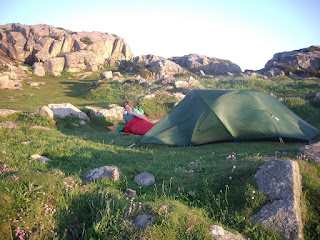
We woke at 5.30 this morning (yes, 5.30), the beach deserted, the Painted Ladies still flying through, a porpoise in the Sound. As I made tea, four choughs hovered on the breeze at Porth Melgan. Thirty minutes later we struck camp and walked slowly back to the car, watching the morning begin.

Good things come...


Sunday, April 19, 2009

Stanage Edge

I'm back again, scrabbling to find my kit, sheltering under the tailgate as I change into Ron Hills and pull on a thermal vest. My map flaps in the wind - it's the wrong one anyway so I shove it back in the rucksack. I'd given Jane directions to get here; take the road by Ladybower resevoir, go up the hill and there should be a pull in by a sandy track heading up to the moors.  It hadn't changed since I last came here; nor had the wind, bitterly cold as it always seemed to be. I pull on a hat, stuff my cagoule in the bum bag and set off.  
It's twenty years since I ran on Stanage Edge and yet it is all so familiar: the dry smell of the grit, the rough friction of the stones, the squelch of the rich chocolate peat when I miss my footing.  As I run up the hill, the sun begins to break through the mist; by the time I am at the summit of Stanage End, the sky is a pale blue. The edge stretches ahead of me, I take off my hat and pause a moment to get my bearings.  A grouse takes flight from the heather, it's red wattles flapping as it crash-lands a few yards away. 
Stanage is the longest of the gritstone edges, a five mile escarpment running from Bamford to the moors above Hathersage.  It is famous for its rock climbs, but despite being a climber for many years I never much liked it as a crag. To me, it was always best as a place to run.  As I start to move again, I remember the reason why I loved it so much.   
It is not so much the landscape, though I like the feel of these open moors looking down on the greener valleys of the Peak District. It is something about the process of running here that is its special joy. You have to place your feet carefully, plan your route between the boulders and the peat - skip up rocks, jump down others, dash through the bogs - and you have to do this at speed, for traversing the ground at pace is what gives running its meaning.  As I run past miles of boulders and soft peat I am conscious of every step and how it feels; I am conscious too of the irony that running in such a beautiful place it is the terrain underfoot that matters most. 
I'm also aware that the faster I run, the more attuned I become to the choices, the decisions seeming to flow, each step leading effortlessly to the next. I find myself thinking of the path as if it were a river: I'm scouting its rapids, adjusting my line, going wrong then putting it right - becoming one with the water. As I reach the main climbing area I have found a natural rhythm, a balance of speed and awareness that for the time being, is all that matters. 
I notice the walkers don't seem to say anything to me; I am something to be avoided, stood aside from as I pass. It is the climbers who greet me, nods, waves, the odd shout of encouragement. Perhaps they too know something of how, though intense effort, we can transcend the particularity of our situation - those who have climbed for long enough would, I think, recognise what I am talking about. The last miles pass without any sense of effort.   
As I start the descent towards Burbage rocks I can see Jane waiting with the car. The last time I ran this route she was here too, on that occasion I would go on, past Burgabe, Froggat, Curbar, Gardoms and Birchins, to finish after fifteen miles at the Robin Hood Inn. But that was twenty years ago, and though returning is one of my chief delights, I know that some things can never come again. 

Monday, March 30, 2009

You’ll come to love both.


The bothy at Moel Prysgau

I remember the first time I drove through Abergwesyn Pass. It was spring and I was living in Cardiff, questioning my decision to move to Wales after a cold grey winter. I wasn't happy in the city, but didn't feel at home in the hills either. Much of South Wales seemed grim; even the Brecon Beacons lacked the stillness I had come to love in my home county of Northumberland. I must have mentioned something of the sort in the office.

Rodger was having none of it. 'I tell you, Wales is the most beautiful and the most ugly country in the world – and you'll come to love both.' Rodger lived above Merthyr, a proper Valleys boy who'd been a coach driver for years and now worked for the local newspaper, though he missed his time on the road. His great delight was to visit customers in Carmarthen or Cardigan – very important area for us but – indeed, he insisted on 'going west' at least once a week.

 'You come with me to make some calls,' he insisted, 'then you'll see.'

We drove the mountain road from Rhayader to Aberystwyth, stopped for quick coffee with a newsagent in town, then – work completed for the day - headed south to Aberaeron. Rodger was on a mission; he drove me to Lampeter, to Dolaucothi, to the wonderful village of Caio (still my favourite place in Wales) and then, by yet another double back, to Tregaron and the road to Llanwrtyd. 'Now is this a mess, or what?' he asked as we drove through an area of young forestry. I murmured agreement, though in truth I took little notice, being somewhat car sick by that point. 'Just you wait,' he said. 'The best pass in Wales is over this hill.'

The Abergwesyn pass is a near perfect glacial valley, cutting deep into the hills from the hamlet of Abergwesyn towards the Llyn Brianne dam and the Mid Wales forests. I was there again this morning; driving through the ancient deciduous trees at the start of the gorge. There was ice on the road, the northern slopes still in shadow by mid morning; on the southern side the bracken was drying in the sun; two ravens were harrying a buzzard. It is twenty years since Rodger took me here, I have driven and cycled this road dozens of times since, and still it takes my breath.

Abergwesyn is owned by the National Trust, consequently it has been saved from the vandalism wrought on the hills beyond. At the head of the pass is a steep road where the forestry begins – appropriately, it is known as the Devil's Staircase. From here westward, swathes of fir trees cloak the hills, the only respite to the monotony being the fell-clearance areas and the Dolgoch hostel, nestling in an oasis of bog that was presumably too awkward to plant. A huge area of land between here and Tregaron has been spoiled – some would say ruined – for what I suspect was little more than politics and the quasi- economics of the forestry commission; but what do I know? 

What I do know, is that the fir trees are every bit as ugly and despoiling as the industrial detritus that litters the Rhondda. And this is only one small area of the Mid Wales forests. Huge areas of the Cambrian Mountains have suffered the same fate, and sadly I suspect it will be repeated – though today it is wind farms more than trees that the politicians want. What was it Rodger said about Wales being the most ugly country…?

And yet I still love this area. Today, I walked to the bothy at Moel Prysgau. It is miles from any tarmac, approached by the old drove road to Strata Florida. The path is stubbornly defiant; it hugs the river, sometimes this side, sometimes that - time and again you have to wade through to stay with it. In a sense it is the reverse of walking the hills of the South Wales Valleys – here the dereliction is above you, not below. 

A few miles in and the trees take over, the paths become forest roads, complete with junctions and rights of way; the views become sporadic. Yet there is remoteness here, a stillness that saves the landscape despite our worst efforts. My son Daniel was with me today, but we walked much of the way without talking. Towards the end of the walk we came to a small boggy pool in a clearing, two geese floated serenely on the water, untroubled by our watching. 'Do you want to chat? I asked.

'I'm good,' he replied. 'It's the silence that I like the most.'

Mid Wales - an object lesson in how to ruin a landscape?

Sunday, March 15, 2009

Wiltshire Sundays


Today, spring arrived in Wiltshire; a milky blue sky, crocuses in bloom and a woodpecker scuttling up the tree outside our house.

Where should we go, I asked; it's forecast for eighteen degrees?

'Let's not go far,' said Jane, and my heart sank.

For the problem with North Wiltshire is, dare I say it, there just isn't that much to do. There aren't any beaches, there are no mountains to speak of and open countryside is hard to find – what little there is tends to be over used and managed to the point that it loses any sense of nature (follow the blue dots or, for a more challenging walk, the red ones). I suppose it's pleasant enough dawdling through the lanes and stopping at ye-olde-tea-shoppes, but on a day like today you know the roads will be full of Sunday-drivers, hooting at each other in the tight lane by the garden centre. In any case, we need to walk the dog.

We went through the usual options: so and so woods (too busy); so and so gardens (too far); so and so country park (too tame); we could always go to the Cotswolds (oh God, please no). It's ironic that for someone who'd put landscape at the very top of his priorities, I live in an area which I dislike. 

That's a bit harsh, I don't actively dislike it here; I just think it's all second rate, and days like today rub it in. If we'd been in Wales, I could have reeled off a dozen options, and whichever we'd chosen I'd be scurrying about to get everyone ready, not wanting to miss the best of the morning. As it was we were still undecided after a leisurely breakfast.

We filled our day in the end. I took the boys to the climbing wall; we visited a National Trust garden billed as Wiltshire's best kept secret (proves my point) and I went for a run through Corsham Court Estate as the sun started to dip. All pleasant enough, and no doubt a delight to many – but I can't help feeling unfulfilled. 

The truth is, I've lived here thirteen years and yet I can only think of two or three places that truly lift my spirit. Perhaps I should look harder – or differently – perhaps I should stop searching for what is never going to be and appreciate Wiltshire for what it is? Maybe then I'll have more enthusiasm; maybe then I'd be scurrying around as soon as the dawn chorus woke me.

On the other hand, if we went to Wales next weekend... we could climb Carn Lleiddi, or walk the cliffs at Ceibwr, or kayak to Ramsey, or look for dolphins at Strumble, or build a beach fire at Abermawr, or watch the sun set over Presseli…

Home, as they say, is where the heart is.

Friday, August 29, 2008

Staying Local


Weather improved these last few days, though still cloudy. I heard today it was the worst August on record for Pembrokeshire.

Whitesands heaving with tourists the moment the sun came out; families cheek by jowl either side of the slip way. 300 yards toward St David's Head is Porth Melgan, a steep sided cove with aqua-marine water and fins of black rock - one family had the place to themselves.

A couple walked past us as we sat at the headland, they were taken aback by the view - a gentle reminder of how special this place is. Wind picking up the tide in Ramsey Sound but I saw at least one porpoise. No seals today.

Rock pooling at Abbereiddy we catch a dozen small fish, a few miniature shrimps and a blenny. At Blue Lagoon the youngsters were jumping from the old quarry platforms, watched by small crowd. I am sunburned this evening.

Monday, August 25, 2008

The Parrog


High tide at the Nevern estuary. Walking the path towards Parrog there is excitement that someone has seen an otter in the reed beds. Few birds of interest - the egret has gone for now. Only one speckled wood and one small white butterfly; a very poor year for butterflies.

The boatclub was full of 'hoorays' wearing sweatshirts, baggy shorts and flip flops. Very few appear to be going sailing. Not sure why I object to them so much - in many ways they are little different from me. Jane says it's a form of class consciousness, which is probably correct, but I sense there is something deeper.

I made a model of an old mine for Dylan's railway - papier mache and poster paint - he seems to like it. Mike plays with him well.

On the internet there is a report of a sunfish and large basking shark sighted at Strumble Head.

Strumble


Strumble Head. Two birdwatchers at the hide, scopes pointing at open sea; notebooks, flasks and sandwiches by their chairs. Evidently they sit there most days, posting their sightings on the internet each evening. I liked their watchful patience - like fishermen with telescopes.

I spotted some porpoises in the run of the tide - perhaps eight or ten, but hard to tell as I may have counted twice over. They are common here. No sunfish today, but they are seen regularly in the summer. A heron flew out to sea.

Both of the spotters' scopes had a large foam shield (10 x 6 inches) fixed around and to the side of the lens. This allows them to look through the eyepiece with both eyes open. 'No need to squint,' one of them said.

Saturday, August 23, 2008

North Wales


A few days in North Wales; a touch nostalgic as we stayed at Cobden's Hotel where we held our wedding reception. It has new owners and was much run down. Sad.

A good day taking Dylan on the Padarn Lake Railway then walking in the quarries at Deiniolen, watching climbers on the slate slabs and marvelling at the men who had worked the quarries out of the mountain. Deiniolen is similar to the villages in the Rhondda.

In the evening we all walked to Cwm Idwal, the older boys scampering up the rocks, Jane and I remembering our first visit twenty years ago and the kiss by the lakeside. We used to go there often. Once we found a red rose tucked into a crack on the Idwal Slabs, with it a note in a plastic bag, from a girl to her boyfriend who had died in the Himalaya.

On our return we stopped at Machynlleth. I liked its higgeldy piggeldy mix of shops, ranging from organic greengrocers through traditional hardware and gift shops to upmarket boutiques selling household trinkets - a number of charity shops too. Museum of Modern Art Wales (MOMA) was disappointing.

Back at Llandeloy the crows are gathering on the wires.

Monday, August 18, 2008

Grey skies


The rain returned this morning; had to dash to the car, the trees bending further than I've ever seen in August. A few diehards at Newgale campsite, otherwise deserted; waves breaking on the stones, spray covering the road.

The osteopath asked me lots of questions gave my back a rub and charged me forty five quid - nice bloke, interesting books on his shelves. First quack I've seen that said I wouldn't need more treatement.

Friends came in the evening; chatted around the usual middle class worries: pensions, our kids' futures, the cost of housing. The children played in the annexe, unaware of concerns next door.

Only a few rooks today, though a flock of gulls came over early evening.

Sunday, August 17, 2008

Clear skies


There were about 100 rooks gathering in the village this evening. They were joined by dozens of seagulls, all of them freewheeling in great arcs over Sunny View, one or two gulls landing on the roofs. The wind was bending the old Scots Pine so some of the rooks took shelter in the fuller trees at the back of the graveyard, but most flew on towards Llochmeyler and Llanrhian. I think I'll try and find their roost later this week. Very wet and windy all day until the sky cleared at night - so many stars it was hard to identify the constellations.

Jane starting to point out the crows.