Showing posts with label Landscape. Show all posts

Sunday, February 6, 2022

Deep and wide...


I have a friend (one of many with similar outlooks) whose attitude to travel is so very different from mine. To her, visiting the same place twice is a wasted opportunity. 'No matter how much I liked my holiday, I'd rather go somewhere different next time,' she'd say, 'After all, there's so much of the world to explore.'  

It's not that my friend is oblivious to the possibilities of familiar places. Rather, it's that she delights in new experiences and (with some obvious justification) associates those with fresh destinations. It's not an uncommon perspective, indeed I suspect it's the majority view. The idea of 'seeing the world ' has a strong pull on the imagination.

But not on mine.

Occasionally in our house, we'll play that game of listing the places we'd most like to visit. Jane and my sons quickly offer up half a dozen suggestions. My answers are always couched in conditional terms: if you offered me a free ticket, I guess I'd choose Patagonia, but if you gave me the cash, I'd spend it going to the Alps...

Not again, they all wail...

My friend, and many in my family too, are seeking a panoramic vista from their travels. For all they might talk of wanting to avoid the tourist hotspots—to see the 'real' country— it's not on their agenda to truly 'know' their destination or feel a part of it in any meaningful sense. Depth of place is not the point or even achievable—it's the breadth, and to a large extent the newness, of experience, that matter most.

I should say here, that I'm not against tourist travel (I've done plenty of it) or indeed, suggesting that my approach is right or better. It's simply a different preference, and one that I sense comes more from resolving what's within than responding to what's without. Or to put it differently, it's about our inner journeys as much as our outward ones. 
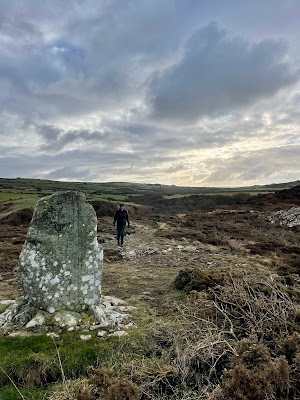
The other week Jane and I went for walk near our home. We followed the cliffs west of Fishguard, a path we'd taken before though not for some time and never in that direction. On our circular route, we passed a series of cromlechs, found hidden bays and near Carreg Wastad point (the site of the UK's last invasion) spotted a seal offshore and another on the beach... and then another.. and another...  In all, we counted over thirty and probably missed as many.

Seals are relatively commonplace here and yet to see them so close, and in that number, was a special moment. But more than that, I learned from this walk many things new about where I live. As well as chancing on the beach, I discovered the cromlechs—three of them as good as lost in the scrub—visited a new village, found a beautiful church... and most of all, enhanced my mental map of this tiny part of my home turf with more detail than was there before.  
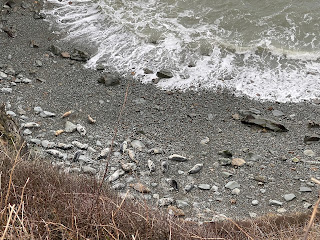
The point I'm making somewhat clumsily is that my experience was fresh and new, not because the place was, but because my knowledge of it deepened.

Perhaps this explains why I take such delight in returning to familiar haunts; why if I had to choose six locations for my bucket list they'd all be repeats of a sort. We have only so much capacity to look and feel and understand, not least in the limited time we have allotted to us. I've been talking here about travel but in truth, the same oppositions apply to more prosaic concerns, just as they do to our professions, creative callings and personal commitments. If the world and our resources were infinite, then I suppose our knowledge and experience could be, as the old hymn goes ... like a fountain flowing, deep and wide...

The tragedy, for us mere mortals, is that we must choose one or the other. 

Sunday, July 18, 2021

Underrated

Falls at Ystradfellte

Often when I walk with Jane she says I may as well be somewhere else. Other couples she points out, use walking as a chance to chat and hold hands, whereas more often than not I'm striding ahead and miles away in my mind  If this seems selfish, then I must beg forgiveness or at least understanding.  It's as if the repetitive act of this simplest of exercises gives rise to meditations that I'm powerless to resist. 

In truth, I'm glad of her presence even if inwardly elsewhere. So in an attempt to bridge the divide, I've recently taken to sharing more of what I'm thinking. I call it 'the kind of things I ponder' conversation and though more often as not it elicits an eye roll,  just occasionally it engenders a discussion that slows my pace and brings us together.  

'Things underrated' I said the other day, is one of my go-to ruminations.  We all have our lists of the best and the worst—the finest restaurant, the funniest book, the town we'd least like to live in... Whatever category takes our interest it's natural enough to rank and rate it in an order of excellence. So much is commonplace and pleasant enough to debate on a hike or a wander.

But 'underrated' is something slightly different.  It's not about what or who is the best or worst, it's about the gap between our perception and reality; it's about changing our focus from a scale based on excellence to a one of latent potential or unrecognised achievement.  

We all know that Pele and Maradona are among the best footballers of all time; but who are the lesser mentioned players that have a claim to be up there with the greats?  And while we're at it, considering what's overrated is a good muse too; which towns and counties, for example, have reputations (or house prices) that far surpass what they actually deliver?

I was thinking of all this in a slightly different context when walking in the hills this weekend.  My son had asked me earlier if I'd visited every national park and which I thought was the best.  I told him I had and although it was hard to pick a favourite I'd probably opt for The Lake District as the quintessential UK example.  Others might disagree with my assessment but that's not the point—which is that I picked an option that would almost certainly be pretty high on any public vote.  

I've no idea if such a survey has ever taken place but if one has I'd bet a lot of money that the Norfolk Broads or South Downs were not contenders for the top medals. And just to add a bit of speculative spice, if I had to declare my choice of 'least favourite' national park, I'd opt for the New Forest. This will no doubt offend some, but then we all have our preferences. And a good thing that is too.

But returning to my theme, and what occupied my walking meditations, which national park is the most underrated?  

Now that's much harder to decide.  Northumberland is the least visited, but for all I love that land, it is actually the coast (not in the park) which draws most visitors.  The North York Moors is relatively little known too, as is Dartmoor; the Trossachs are often passed over in favour of the Highlands or West Coast. And what about Exmoor, surely there's underrated potential there...  

Magnificent as these parks are I fear they will always be overshadowed by other attractions—none of them has the latent possibilities I'm looking for. On the other hand, I can't in all conscience choose the Yorkshire Dales, the Peak District or the Cairngorms: these are obvious star performers, well known and well-trod by millions.

There's no right answer of course.  

For what it's worth I'd make the case that the Brecon Beacons is the UK's most underrated national park. It's within an hour's drive of four large cities, has some of the best mountain walking south of Scotland and is vast and varied and lonely and lovely... 

Why is it so little visited compared to others?  Frankly, I'm mystified but I sense the lack of an obvious tourist centre (like say Keswick or Hawes) plays a part—so too that its major peaks are just a touch under 3,000 ft.  Maybe the Welsh language is off-putting to some - all those consonants and not enough vowels. 

The trouble of course is that what would make it more attractive to many risks destroying why it's so brilliant for the few. 

On Saturday we stopped by Maen Llia, a standing stone of  4,000 years provenance; erected by the Beaker people, we can only guess at its significance. Legend says it occasionally walks to the nearby stream for a drink—waters that feed the magnificent falls at Ystradfellte, and which hollow the caves at Dan yr Ogof, the biggest underground system in the UK.  From the hills above here, you can see the Carmarthen Fans, the Brecon Beacons, the Black Mountains; hundred of miles to explore.

And you can do so alone, or together, or like me and Jane, a bit of both! Because other than the honey pots (of which the waterfalls are one) the visitor density here is among the lowest of any high mountain area within easy reach of millions of people. And because, in a landscape like this, we are drawn to looking in as much as out, and to talking to ourselves, as much as our closest of loved ones. 

And I reckon that's underrated too. 

Saturday, April 18, 2020

The role of the countryside in helping us through this crisis.

Snowdonia - above the Glyders.

The events of the last few weeks will be with us for decades. Economically, there’ll certainly be pre and post Covid eras, and socially, though evidence shows we swiftly revert to our norms, most commentators expect there to be some adjustment. I wonder though, as I reflect on the ‘Stay Away’ sign that’s appeared in a lane near my house, at the deeper changes this shock to the system will bring, and the attitudinal legacies it may leave?

Somewhat to my surprise, I’ve coped well with the restrictions of the lockdown. I suppose that being an introvert, I was always going to be less affected by the lack of social interaction than I was by the limits to getting outdoors. In the event, I’ve adapted to that too, finding new ways to explore, making a virtue of what’s local; dwn ei filltir sgwar, as they say in Wales – a man of his own square mile.

But for all that I’ve found solace on my doorstep, there’s also been sadness – not in the landscape or the shrinking of my horizons, but in narrow minded insularity which the sign in that lane so typifies. Walk two miles from where I’m writing this and you’ll find others of similar ilk: Stay Home, Caravans not Welcome, No access – the internet is awash with much the same and worse.

Fear, of course, feeds our darker instincts. In the first grip of a pandemic (that very word is so emotive) we want action that keeps us safe - we don’t care about fancy pants reasoning or the niceties of whether this or that restriction offends against our individual rights.  And actually, I agree. Over sophistication would risk undermining the core message – especially when there are sections of society who seem to be determinedly irresponsible and selfish.

But that doesn’t mean, we shouldn’t call out attitudes and behaviours that in any other context we’d be quick to condemn. Of course, an urban exodus to Tenby beach or Pen Y Fan should not be encouraged – and those who flout the rules should rightly be penalised. But when the call to stay at home starts to morph into a more general ‘outsiders not welcome’ then we risk crossing a line. Last week, the tires of suspected ‘visitors’ cars were slashed in communities across Wales; there were farmers calling for footpaths to be closed, there were people posting pictures of suspiciously parked vehicles – and there were keyboard warriors glorying in the Easter stay-away, not as a regretfully necessary measure, but as a statement of neo-tribal identity.

If this were just a few individuals then perhaps I could shrug it off. But regretfully, some of those who should know better have acted poorly too. The posts on social media by the Pembrokeshire National Park for example - with their sideways digs at caravaners and second homeowners - are ill thought through, reinforcing an undercurrent of ‘us and ‘them’ that no afterthought of ‘you’ll be welcome when it’s over’ can ever mitigate.  In part, that’s because it isn’t going to be ‘over’ – at least not for a long while, and not in a clean cut way.

The real sadness in all this is that rural areas have – at least potentially - an important role to play in helping us come through what will be a messy and imperfect emergence from this crisis. If we think of those few environments that can relatively safely allow for exercise, wellbeing, families to be together – then the outdoors must come high on the list.  This week, it was reported that the Government is considering the restarting of construction projects on the basis that working outside poses a limited risk – then surely walking, or mountaineering, or surfing or sailing…must be even less so. 

On Thursday there was some clarification that the current legislation allows for a short drive of up to five minutes in order to take a much longer period of exercise. To many – myself included – this makes a huge difference to their horizons - and ultimately their mental health. We should welcome the clarity rather than feigning confusion or retreating to the comfort of inflexible prescriptions. For these are exactly the types of baby steps we will need, helping us to move beyond slogans without compromise to safety or leaping from one extreme to another. I’d like to see our National Parks (and other similar bodies) start thinking – and communicating – along similar lines, rather than promoting the blanket closure of our precious natural resources.  

But most of all, I’d like to see a change in an underlying attitude of ‘us and them’, which if not universal is worryingly to the fore. Those of us lucky enough to live in rural areas – and especially those with the ability to influence others - must come to terms with the reality that there will inevitably be some risk from visitors arriving from the city – just as those in urban areas are now taking daily risks to supply us with food and medicine and telecoms and building materials…  We live in an interconnected and mutually dependent society and the idea that its ‘our’ local health service or ‘our’ landscape or ‘our’ footpaths and that these regional assets are most definitely ‘not yours’, is not only wrong in its reasoning, it’s shabby in sentiment and actually, bad for our future too.

Last week I was struck by a simple Facebook post from my friends at Alpine Action Adventures - they were offering key workers a substantial discount on any holiday they might take this or next year. Sure, it’s a marketing device; but what a fantastic and creative gesture. They have other offers too and are responsibly encouraging guests to think ahead without the need to risk large deposits or inflexible commitments. What they are saying is Come and stay, we’re grateful for what you’ve done; we’re happy to share some of our good fortune - and these are people who live in France!  Let’s have more and similar gestures from businesses and public bodies here in the UK.

My grandfather, who lived through the great depression, was fond of the saying ‘we reap what we sow’. These too are seminal times, and we should grant some leeway for the planting of a few bad seeds. But in a few short months, the communities and the landscapes of rural Wales will have a golden opportunity to show – and share – the depth of their value to us all. In so doing, they can make a huge contribution to our national wellbeing and play a vital role in shaping some of the few positive legacies of this pandemic. Rather than putting signs on gates (either literally or online) we ought – right now - to be thinking of how we might embrace that challenge, even if the ways to do so are not immediately obvious.   

Sunday, June 11, 2017

Land of my fathers

Russell's Cairn on the summit of Windy Gyle.

Next winter, it will be three decades since I came to Wales; more than half my life, and a long time more than the 'two or three years' I'd planned to stay. I love it here and suspect it's where I'll see out my time. But the true land of my fathers is Northumbria, at the edge of England, where the sky is sharper, and the sun rises over the sea.

I wrote recently of the backpacking trips I made as a student. That was in the early Eighties, around the time I became closer to my maternal grandfather. He too loved the outdoors, and though in his seventies, came with me on many trips to the mountains. I remember in the summer of 1981, climbing the Simonside Hills on the morning of the Royal Wedding, where we met a group of similarly lost souls, looking for somewhere to escape the madness. And I remember too, around the time I returned from university, me showing him the route to Windy Gyle.

Last week I was there again; this time with my son Daniel. He's just finished his degree and wanted to talk about his plans. I suggested we go to the hills but chose the route without any conscious nostalgia. For all that, it never fails to surprise me, how our histories have a habit of repeating themselves - as we set off, I packed my bag with the same OS map I'd used thirty-five years before.

The walk begins about as far into the Cheviots as you can reach by road. To get there, you must first pass the Rose and Thistle at Alwinton, where Sir Walter Scott wrote Rob Roy. There were cyclists heading our way, waving us through as we drove by the banks of the upper Coquet. It was warm for early morning, only thin trails in the sky; the deepening valley stirring memories of times that that had shaped me, and yet lain dormant for years.


Not everything is the same as it was: there's now a car park at Barrow Burn and new information signs from the National Park - but otherwise, this place feels timeless. Our route follows the drover's road to the border fence, briefly joins the Pennine Way, ascending to Russell's Cairn on the summit. Like much of the Cheviots the path is soft underfoot, the climbs more rounded than steep; a view that relies on the changing light to give form to its barren beauty.

We reach the cairn in less than two hours and drink greedily from our flasks. My thirst reminds Daniel of a trip ten years earlier, when we had walked together along the Preseli ridge back home in Wales - it was he who stumbled on the hidden stream that allowed us to camp by the bluestones at Carn Menyn.  The story of that journey - and how it helped me see Daniel anew - became the opening chapter of my book, Counting Steps.

You're not going to write about this as well, he asks?

We returned down the valley past Row Hope farm, drinking our fill from the clear water springs. There were skylarks above us, small heath butterflies in the dun grass, and two ravens patrolling the slopes to our left. I check the map and the words on the battered paper invoke a subconscious smile: Headless Clough, Mosie Law, Rough Knowe, Black Braes...  These are names and language of the northern fells; a lexicon that was once as familiar to me as the Celtic equivalent of where I live now.


But I sense there was more to my involuntary smile than a recalled familiarity. The landscape of our childhood - or more particularly, the place where we 'come of age' - has a profound hold on our sense of self. I'm sure that's why so often we define ourselves in relation to where we were born; why so many of us, despite our peripatetic lifestyles, seek to return 'home' in later years; and why, on the occasions that we do, we feel a depth of belonging that transcends the here and now, connecting our presence to the past, and even to lost generations.  As I've got older, I've come to realise, that what in Wales they call Hiraeth, is not unique to the Welsh.

Ironically, my own father did not like the hills, preferring the town, or at a push, the sea. But in fairness, he too stayed resolutely a man of his place. One of his few questions, when I visited before he died, was to ask how it had felt to cross the River Tyne - true Geordies cry, he'd said.  I lied, (though not with intent), telling him that home meant nothing to me now - I'd moved away and wouldn't be coming back.

If only life, and the paths we take, were that simple.


Thursday, March 23, 2017

Reflection and adventure - at the Refuge de Chavanes


Twenty years ago (a little more actually), on plane from Nepal, I had a fleeting encounter that has lodged with me ever since. After kayaking the Kali Gandaki River I was flying home with amoebic dysentery as a souvenir – next to me sat a Nepalese businessman, who in making conversation was curious as to why I should visit a country that could make me so ill?

I remember explaining that Nepal was special, the mountains higher and the rivers more remote than could ever be found in Wales. ‘Then go to the Alps’ he replied, ‘you can have just as grand adventures there!'

I recalled this conversation last week, high in the mountains of the Haute Chablais, as the ridges of the Pointe de Chalune blushed crimson in the embers of the light. That afternoon, a group of us had skied and snow-shoed from the Vallee du Brevon to the remote Chavanes refuge. It sits in the shadow of a glacial cirque, to the south of Les Gets, about an hour from Geneva.

I’d not worn snowshoes before. In a sense, that was an adventure in itself: adjust the heel, strap in toes, check for grip as the baskets flex... At first, I’m glad of my poles, but soon I’m into my stride, scanning for crossbills as we pass beneath pines that are laden with cones. There are tiny spiders scurrying between the fallen needles, and I try to avoid them by shoeing in the rutted snow.

An hour later, we reach an isolated chalet. There is running water and an improbable earth closet for passers by, though the prospect of undressing persuades me it’s easier to pee around the back. We gobble cheese and salami as Simon, who’s been here before (and is ex-navy so can’t help but command), gives us a briefing: it’s steeper from here, there’s ice on the track; be careful towards the top.

Some in the party are using skis, attaching ‘skins’ that resist backward slippage when the ground gets steeper. It looks an odd way to travel, and all the more so in the knowledge of the lifts and gondolas on the other side of the valley. Eddie tells me it’s like fell walking, only with on planks on your feet - he explains that it might look hard work, but there’s a deep satisfaction in making the summit under effort.   As he talked, I remembered the last time I climbed Snowdon; the contrast between the walkers on the summit, and the crowds, making a beeline to the café from the Llanberis train.  

My snowshoes grip well on the steeper ground, they have integral crampons that bite into the ice, and a ‘heel raiser’ which takes pressure of the calves. Though I start in the lead, the others gradually pass me. A year with a dodgy knee has added considerably to my ‘pack’, but overall, I reckon I’m not going too badly for an old man. Leanne, who looks as though she could skin up in half the time, kindly stays to keep me company. She too has travelled widely, but talks eloquently of her love for the Alps, and desire to keep on returning.

Eventually, the trees give way to more open ground, and the final pull is less steep than I’d feared – the others have waited at the rise. We’re in a ring of granite and ice, cradling a bowl of trackless snow; above us are the peaks of the Chavannais, the Chavasse, Chalune and Haute Pointe  Nobody is saying very much.

At the refuge we meet a walking party from Thonon les Bains; they are leaving after what seems to have been a fine lunch. The refuge is owned and manned by Claudius, who, in his visitor books, is variously described as a ‘sage’ and ‘mountain gourmand’.


So perhaps unsurprisingly, we are welcomed with mouse de cider and wine laced with hazelnut syrup. At night he serves us prunes in bacon, followed by chicory salad, pain de campagne, beef bourguignon, a cheese board the size of which I’ve not seen before… and some apricot cake to finish.

And then, there were the wines.

They began with a liqueur de prune, followed by a homemade apricot, some sapin and cassis, and, of course, a little genepi to finish… At one point I counted nine bottles on the table, but it was getting hard to focus.

I’ve been visiting mountain refuges for more than thirty years and the Chavanes is certainly on the rustic side, but its food and ambience are among the best I’ve discovered. The company was a delight too, reminding me that for all I occasionally dream otherwise, I prefer the warmth of friends to the solitude of journeys made alone.

Which, in a roundabout sort of way, brings me back to the man on the plane from Nepal. I long ago came to the conclusion that he was right. I’ve been exploring wild places for all of my adult life, and am fortunate to have easy access to the Alps – but the truth is, we don’t need to go very far, or always to be alone, to find adventure.

The Valley de Brevon is a stone’s throw from the Portes de Soleil, and yet, a million miles from the après ski of Morzine. I could show you places that are much the same in Wales, The Lakes, or Northumberland. Only last month the definitive Scottish Bothy Bible was published – there’s enough inspiration in its pages for a lifetime.


The next morning (after breakfast by Claudius) we descended to the bustle of the valley, and I reflected on the simple, life-affirming, trip we had made together. The Chavanes refuge is, to use an expression coined by the Himalayan explorer Mo Antoine, as wild and as wonderful, as I need to ‘feed my rat’. He meant, by that, to ‘scratch the itch’, to sate his quest for adventure. 

I understand what he meant, and feel privileged to have done something of the same.

Friday, November 8, 2013

Because it's there

Y Garn, Snowdonia

Because it's there, is the line attributed to George Mallory, answering the question of why he wanted to climb Mount Everest. It's probably the best known summary of what drives mountaineers.

That's understandable because the quote is a memorable and witty encapsulation of an urge which is beyond the comprehension of some. It also works at a deeper level, in hinting at the sense of adventure, the pull on our imaginations, which mountains evoke.

A strong candidate for the opposite of Mallory's line is the quip I must have heard a thousand times - there's a path round the back you know! Not only is this not witty, it hints at nothing but a lack of originality in the joker who called it out.

I'm being unfair in that last paragraph, for while it's perhaps best to grin politely at the wags, it's more difficult to answer their underlying question - why are you risking so much on something so intrinsically pointless?

The problem with the Mallory quote is not that it's wrong, but that it's incomplete. The motivations for climbing are many and complex, and no soundbite is ever going to be a credible answer.

Alfred Wainwright said that we climb mountains, not for the view from the top, but from below. I understand his point - climbing a mountain changes our perception of the landscape. We look differently at mountains we have climbed - we have association, familiarity, a shared history.

There are other reasons too - for bravado, for status and pride (at national and personal levels); popular at present is raising money for, and awareness of, good causes. The recent proliferation of 'adventure sports' draws on these and many similar motivations.

But as explanations, they remain incomplete.

For in my view, tackling all but the most casual of mountains, involves an inner as well as an outward journey.

It's well understood that the hardest routes require as much composure as physical strength. But 'control to power' is not what I'm getting at.  Rather, it's the counter-intuitive fact, that by being so physically all-consuming, climbing gives us a space to reflect and rejoice - to feel more alive - that is so difficult to find in our daily lives. At its best climbing helps us come to terms with the world and our place in it.

In a sense, we climb not because it's there - but because we are here. 

Sunday, November 3, 2013

Heaven bespoiled

Proposed development on Belford Moor

Last Tuesday  I wrote an email to my friend. It read: Please God, they say no to this one. 

I attached the same photo as the one above, pressed send and could feel my body welling with anger. Eight words were all I could muster without lapsing into expletives.

But I'm going to now - of all the places, in all the world,  I'd rather there wasn't a fuck-ugly windfarm it would be here.  I'm still so drunk with rage at the prospect, that this post is going to be difficult to control.

The place of course, is Belford Moor - the piece of heaven about which I wrote yesterday. As we were driving down the hill I'd noticed a yellow sign on the fence below the rise: No turbines - object now!  I could have been sick at the wheel.

What are we doing to our landscape for goodness sake?

It seems we're seriously considering nine massive turbines that will bespoil one of the most precious landscapes in Northumberland. They will destroy the moor, ruin the skyline; be visible for miles and miles and miles. What's more, we'll subsidise this destruction beyond compare, ensuring a massive profit for the generating companies, who frankly don't give a toss for the place and its importance as part of a wider landscape.

And in return for this destruction?

Let me put this as fairly as I can...
  • We'll generate a trickle of electricity, that will do next to bugger all to help the environment. 
  • The community of Belford might (possibly) get some paltry compensation. 
  • A few metropolitan policy makers and environmental campaigners will feel smug because they've made another notch towards an arbitrary and meaningless target 
Okay, that's a one-sided view - but then you see these darn turbines are like that.  Because it takes just one decision to ruin the landscape for a generation - and we have one chance to to save it.


Photoshop representation of proposed wind farm

I've been clear many times on this blog that I hate windfarms with a passion.

But this time it is deeply personal - for the first time in my life, I think I can truly understand how the road protesters at Newbury felt, how the peace camp campaigners at Greenham Common felt, how those on the Kinder Trespass felt...


The picture above is not an artificial representation - it is the already devastating impact we've sanctioned on the area to the south of Belford Moor. 

Next time you look at a windfarm imagine it being in your most precious place. If you're one of those many bloggers with a picture of a personal landscape on your homepage, imagine it covered in turbines. If you're visiting the countryside this week - imagine it as a semi-industrial site with access roads and restrictions and whirling blades...

And if none of that worries you, then you're made of different stuff to me.

Please God, they say no to this one.

Saturday, November 2, 2013

My piece of Heaven


On Tuesday morning, arriving at the Lindisfarne causeway, I realised I’d miscalculated the tides. The crossing to Holy Island wouldn’t be clear till midday; we had an hour or two to kill.

No matter, I said to Dylan, we can go to the best palace ever, instead!

For thirty years, if anyone has asked me about visiting Northumberland I’ve a list of recommendations to hand. And amongst the tourist highlights (Hadrian’s Wall; the Simonside Hills; Bamburgh Castle) I always include one or two personal favourites. You’ll not find these in a guidebook, I say - but trust me; make the effort, and they’ll stay with you for life.

The top of that secondary list is Bowden Doors on Belford Moor. It’s a high sandstone crag on a windswept hill halfway between the coast and the Cheviot. To reach it you take the road toward Wooler, park by a gate on the summit, and head north across a sunken field for what appears to be a jumble of stones.

By this time, trust in my recommendation is probably wearing thin. But round the corner of those first rocks and you’ll see the point. Bowden Doors is the best and best-situated sandstone crag in England; rock climbers know it intimately and the likelihood is there’ll be some scaling its cracks and walls. At its far end is the ‘wave’ a gobsmacking geological feature that’s worth the visit in itself.

But Belford Moor is much more than a climbers’ playground.

This landscape is where the Vikings first came to Britain; it’s where St Cuthbert’s body was hidden for seven years; long before that it’s where Neolithic peoples carved the rocks with cups and rings. It’s where hares and geese and ravens have been coming for millennia.

As we clambered to the top of the rocks the panorama of the coast and the cheviot opened before us. I reminded Jane that when the time comes it is here that I’d like my ashes scattered. Really, she scowled, after all this time – and not in Wales? 

You could do half and half, I joked.

But in truth, this is my piece of Heaven. It is where I first climbed; where I came of age; where I learned the healing power of landscape. Despite long absences in recent years, it remains my favourite place in all the world. The view, the sounds, the smell and feel of the air, are imprinted on my soul.


As we left, the clouds were scudding from the west, dark shadows on the heather and bracken. Dylan was a little behind us, standing on a rounded boulder, screaming my name into the wind. I waited for him and we walked the last yards together - a vista of castles and coast unbroken below us.


Only when we got back to the car did I see the warning of an impending horror... 

To be continued...

Friday, November 23, 2012

On the edge


Come to the edge, He said. They said, We are afraid. Come to the edge He said. 
They came. He pushed them... and they flew.    
Guillaume Apollinaire

Edges are special places.

Today I drove down the coast of Wales. There must be few finer sea views than that from the road above Cardigan Bay. The arc of Portland to Lyme Regis runs it close, but the South Coast lacks the glimpses of Snowdon and Bardsey; the sense of imminent landslip, as if you could at any moment, tip into the void.

But for all I love the coast, it's the mountain and moorlands I associate most with edges. The very word in Derbyshire refers to the gritstone cliffs that ripple the landscape: Stanage Edge, Froggat Edge; Birchens Edge... Here there's been no meeting of land and sea in recent millennia; instead, there's a feeling of height (often more so than the map confirms), and, I find, an urgency to keep moving, as if the ridges 'need' to be tramped, rather than pondered on.

In Northumbria, where I grew up, the Whin Sill fault determines much of the line of Hadrian's Wall. I remember walking it with my maternal grandfather and him explaining how two ravens were using the ridge lift to maintain their glide. I think of him every time I watch birds hovering, wings to the wind.

The Whin Sill begins or ends at Lindisfarne depending on how you look at it. The other end or beginning is at High Cup Nick, above Dufton in the North Pennines. I went there a few years back, to walk the edge with Daniel. We sat by the downfall at the cliff's highest point, the ridge lift carrying the water upward from the cleft, spraying over our heads.


As I come to think, there are dozens of edges, in one form or another, that have been sites of significance and now memory: Striding Edge on Helvellyn (my first 3000ft mountain), Tossen Edge in Coquetdale (with my grandfather), Fan Brychieniog above Llyn y Fan Fawr (with Jane) Sharp Edge on Blencathra (with my dog), and Bowden Doors, and Curbar Edge, and Wingather Rocks, and Abereiddy, and the White Tower, and Pemmaen Dewi and the Black Cuillin and Aonach Eagach...

Come To The Edge

Come to the edge.
We might fall.
Come to the edge.
It's too high.
COME TO THE EDGE!
And they came,
and we pushed, 
And they flew.

Christopher Logue

Tuesday, October 23, 2012

Cefn Croes wind farm


Let me start by sharing three recent conversations.

The first, with a writer who was once a prominent road protester. Would you have climbed those trees to stop the building of a wind farm, I asked?

The second, with a writer and environmentalist, as delightful as she was committed. I care most deeply about the landscape, I explained, my view on wind farms is really a matter of personal priorities.

And the third, with a writer whose generous mentoring has helped me more than any other. I've discovered the way to success, he said. Write nothing controversial, acknowledge all opinions and say bugger all of consequence.  He had a twinkle in his eye.

I recalled these snippets as I neared the summit of Pen y Garn on Saturday, walking on a treble-width forest track, five miles east of Devil's Bridge in the Cambrian Mountains. The 'road' leads to the Nant Rhys bothy, arguably the most perfect and isolated of all in Wales.

Of course, I knew what to expect. After all, I'd been this way before. I'd written of my hatred of the Cefn Croes wind farm, its impact on the landscape and the inappropriateness of its turbines. I'd gone so far as to say that before passing judgement every campaigner (for or against) should stand under one of the monstrous contraptions.

You'll understand then, I'm no fence-sitter on this issue - though it's fair to say that over recent years I've tried harder to listen to alternative views. Sometimes I even find myself nodding.

But as I crested the rise that visceral response hit me again... I began ranting to my walking companion... and again... reeling off photos... and again... spitting into my iPhone's voice recorder: fucking turbines.. and again... arrogant, criminal... and again... they make me want to puke..  I was listening to no one and to trucking no arguments.

And you know, I was glad about that. For in those few minutes of rage I felt more authentic than any amount of reasoned argument, probing questions or careful assessment of perspectives. I didn't give a toss for the technical reports available as pdf downloads, the website propaganda of the energy companies or the paranoia of the eco-lobby that positions windfarms as a binary alternative to nuclear-fuelled wastelands. Nor did I care about the European grants, the Welsh Assembly's Sustainability Strategy, or the 40,000 homes putatively benefiting from this 'clean' energy.

What I cared about was this place.

The Elenydd wilderness is one of the few mountain regions worthy of that epithet. The Cefn Croes windfarm is barely visible from the road, it takes miles of walking to get up close, it directly affects but a handful of homes and doesn't offend the tourist's windscreened view of Wales. And that's precisely why it matters so much.

This landscape is precious; it's rare and special, and I'm angry because we despoil it with industrialisation on a scale that would be unthinkable in any urban equivalent. This is wrong, and it's plain and obvious when you go there. But because most of you won't, I'd ask you to spend 14 seconds watching the video below.

Just sometimes it's entirely rational to follow our gut.

Friday, August 31, 2012

Soar-y-mynydd and Llyne Brianne


The Soar-y-Mynydd chapel is often cited as the most remote in Wales. I'm not sure how that calculation is made, but it is certainly one of the most beautiful and makes for a fine pilgrimage when walking or cycling in the Green Desert of Wales - a Victorian description of the Cambrian Mountains which, in many ways, remains appropriate.

In describing Soar-y-Mynydd as beautiful, I'm defying convention: austere, would be equally apt; forbidding, not out of place. But then beauty comes in different forms. My neighbour is a stonemason who's indifferent to ornate carving but delights in the millimetre accuracy of cathedral pillars. He would like Soar-y-Mynydd, not for its stonework, but its simplicity: the symmetrical arrangement of the boxed pews, the lack of adornment, the sparse use of colour.

I like the windows too, tall with Gothic points inside a rounded arch, no stained glass. They remind me of my junior school, which is perhaps not surprising because the chapel was conjoined to one until it closed in the 1940s. To picture the community then is to imagine a lost world. Last weekend, three cars were parked on the drive; the information board says that in its heyday, sixty horses were regularly tethered on Sundays!

The landscape is transformed too. Down the hill is the Llyn Brianne reservoir, built in the Seventies to provide water for South Wales, it consumed the upper Tywi to near its meeting with the Doethie. Interestingly, I can't find a reference to the name of the valley before it was flooded (the river above it is the Camddwr, but perhaps it was just known as Tywi). An excellent local website says the reservoir is actually a misspelling of a minor tributary, the Nant y Bryniau (literally, the stream in the hills).

Above the waterline are the ubiquitous conifer forests that cover too much of the Cambrian Mountains. To be fair, the planting began long before the dam was constructed, and, of all the mid wales reservoirs, Llyn Brianne seems to blend more sensitively, even delightfully, into the hills. We walked a five-mile section last Sunday and saw redstarts, dragonflies, a tortoiseshell butterfly and a soaring buzzard - no kites at the dam, but they were there at the RSPB reserve below.


I first came to Llyn Brianne a month after moving to Wales, mistaking the mountain road as a potential easy option on a cycle tour. In the twenty years since I must have returned at least once each year, often more. Reflecting last weekend, I realised its become central to my image and understanding of this part of Wales. And it's full of good memories too -  of nights in the Dolgoch hostel, of backpacking with my boys, cycling the Tregaron road - of my friends kayaking the overspill on the dam (an activity now banned).

And of Soar-y-Mynydd too. I have no religious faith, but if I did, I think I'd be 'chapel' not 'church'. So it's good to know the pews are still used - and sometimes even filled. For Soar-y-Mynydd has become an oasis in the desert - parishioners travel miles to attend its services, and evidently, preachers consider it a great honour to be invited. A friend told me they are all firebrands, bible-bashers of the old school. I like the thought of them ranting as the rain hammers the windows and the Avon Camwddwr runs brackish and inextricably towards the dam.


Friday, March 16, 2012

The water in Majorca...


Those of a certain age might remember an old Heineken advert. It was a send-up of My Fair Lady and featured a Sloan Ranger being trained to talk in a cockney accent. She fails miserably until one swig of the amber liquid has her drawling, The worta in madjorca, don't tayste like it orta! 

This last week I've been to see for myself- not drinking lager but riding my bike with Andy Cook Cycling. It was my first visit to Majorca, and before going I'd have struggled to say much about it.  If you'd pushed me I'd probably have ventured that Magaluf wasn't quite my kind of town! The truth is, our pre-conceptions of places are often pejorative and unfounded - and no more so than mine of this stunning island.

The day I left, my friend and blog-hero Michelle sent me an email vouching deep envy. She'd once worked on an environmental project in the mountains near Alcudia - by coincidence, where I was staying. She wrote of eagles and kites, of fabulous coves and of ancient monasteries in the hills. I saw all of these and more, riding 400km in the Serra du Tramuntana, through orange and lemon groves, under cobalt skies and a temperate sun. On Wednesday I rode to Cap Formentor, the northern-most tip of the island - mile for mile I can't think of a more scenic ride in thirty years of cycling.


It's estimated over 80,000 bikers come to Majorca each year, providing an early boost to the tourist season. I vaguely knew this, but wasn't aware how comprehensively the island has embraced the influx: the resurfaced roads, the signed routes, the cafes with free oranges and cakes, the cries of hola from the locals. Add those to the mountain landscape and it is near enough cycling heaven.

You might suppose that hills and heat would make it more like a cycling hell. But it's surprising how the landscape inspires. One lady on our trip had never peddled more than 30 miles; she rode 100km with us on Sunday and beat me to the top of a 400-meter climb. I spent much of another day riding off the back with Andy, the trip organiser and a friend who goes back almost as far as those Heineken adverts. Confidence makes the biggest difference we agreed, and I thought how it applied to him too; he left a steady job to started his business two years ago, a leap of faith that's paid off in self-belief as much as financial returns. Hopefully, both will continue to grow.


I came home on Thursday, into a damp Bristol with the usual queues and traffic jams. Today I rode the Fosseway in a southwesterly headwind, the sky inking and the temperature barely 6 degrees. Not quite cycling heaven, but just as surprising in its way. Recently, I lamented the ripped hedges on Common Lane and doubted there'd be bullfinches there this year. Yet as I turned for home, a male was calling from the top of a hawthorn, its peach-pink chest as dazzling as the Majorcan sun - actually, that's not quite true, but you know what I mean.

Saturday, November 19, 2011

The emotional landscape


This morning I went to the village of Helpstone, birthplace of John Clare: poet, naturalist, lover of landscape. His grave is in the churchyard, his family cottage restored to a museum. I was there for a meeting of writers and artists, but slipped away to look at what's become of the place that had so inspired him.

There's been a surge of interest in Clare, elevating his status from 'the chap who wrote about birds', to that of a more significant poet whose environmental message is about as contemporary as it gets. Clare dismayed at the loss of species as the enclosure act started a process that would change irreparably the landscape he loved.

I'm no expert on Clare, but I was struck by how prescient his message was. The loss of biodiversity and the broader environmental agenda is universally acknowledged as one of the most important issues facing the world - by comparison, the recent Euro-zone crisis pales into insignificance.

But perhaps less obvious is Clare's emotional connection with the countryside that has become commonplace too. The concept of landscape, as we know it now, was barely conceived at the time he was writing. Yet today, it seems to me, we care deeply for those places that are most familiar and hold personal significance. And there's no objectivity to our passions - there's scarcely a region I've visited where the locals don't claim it be the most beautiful in the country.

I'm no different. The places that matter to me most, and which I regard as most splendid, are those I know best. It's my intimate association with Wales and Northumberland - rather than any objective assessment of their scenery - which shapes my view that they're our finest landscapes. And this emotional connection shows in other ways too.  My loathing of windfarms is unashamedly visceral; an instinctive desire to protect our wild spaces from a desecration that I 'feel' almost as a physical pain.

This afternoon I was hurrying home through Leicestershire, not a county I'd put high on my list, despite three years at university there. But as I passed through Uppingham I stopped by a small pub to read the map, and suddenly realised I'd been there many times before - it was on the route I'd cycle to visit my girlfriend in Peterborough. Driving on I thought about those rides, remembered days when my body was strong, felt the gentle ache of nostalgia... And as I did so, the sun came out (or did I just notice it), the views got wider, the trees more golden - and the landscape changed in a way I think John Clare would have deeply understood.

Sunday, April 19, 2009

Stanage Edge

I'm back again, scrabbling to find my kit, sheltering under the tailgate as I change into Ron Hills and pull on a thermal vest. My map flaps in the wind - it's the wrong one anyway so I shove it back in the rucksack. I'd given Jane directions to get here; take the road by Ladybower resevoir, go up the hill and there should be a pull in by a sandy track heading up to the moors.  It hadn't changed since I last came here; nor had the wind, bitterly cold as it always seemed to be. I pull on a hat, stuff my cagoule in the bum bag and set off.  
It's twenty years since I ran on Stanage Edge and yet it is all so familiar: the dry smell of the grit, the rough friction of the stones, the squelch of the rich chocolate peat when I miss my footing.  As I run up the hill, the sun begins to break through the mist; by the time I am at the summit of Stanage End, the sky is a pale blue. The edge stretches ahead of me, I take off my hat and pause a moment to get my bearings.  A grouse takes flight from the heather, it's red wattles flapping as it crash-lands a few yards away. 
Stanage is the longest of the gritstone edges, a five mile escarpment running from Bamford to the moors above Hathersage.  It is famous for its rock climbs, but despite being a climber for many years I never much liked it as a crag. To me, it was always best as a place to run.  As I start to move again, I remember the reason why I loved it so much.   
It is not so much the landscape, though I like the feel of these open moors looking down on the greener valleys of the Peak District. It is something about the process of running here that is its special joy. You have to place your feet carefully, plan your route between the boulders and the peat - skip up rocks, jump down others, dash through the bogs - and you have to do this at speed, for traversing the ground at pace is what gives running its meaning.  As I run past miles of boulders and soft peat I am conscious of every step and how it feels; I am conscious too of the irony that running in such a beautiful place it is the terrain underfoot that matters most. 
I'm also aware that the faster I run, the more attuned I become to the choices, the decisions seeming to flow, each step leading effortlessly to the next. I find myself thinking of the path as if it were a river: I'm scouting its rapids, adjusting my line, going wrong then putting it right - becoming one with the water. As I reach the main climbing area I have found a natural rhythm, a balance of speed and awareness that for the time being, is all that matters. 
I notice the walkers don't seem to say anything to me; I am something to be avoided, stood aside from as I pass. It is the climbers who greet me, nods, waves, the odd shout of encouragement. Perhaps they too know something of how, though intense effort, we can transcend the particularity of our situation - those who have climbed for long enough would, I think, recognise what I am talking about. The last miles pass without any sense of effort.   
As I start the descent towards Burbage rocks I can see Jane waiting with the car. The last time I ran this route she was here too, on that occasion I would go on, past Burgabe, Froggat, Curbar, Gardoms and Birchins, to finish after fifteen miles at the Robin Hood Inn. But that was twenty years ago, and though returning is one of my chief delights, I know that some things can never come again.