Showing posts with label France. Show all posts

Tuesday, August 9, 2022

The traces we leave...

Earlier this week I disposed of an old bedside cabinet at our house in France. It was one of those items you feel guilty for dumping, but deep down know the charity shop won't want either. For the last two years, it's stood by our front door so the postman can leave small parcels. When the mice took up residence, it was time to let go.

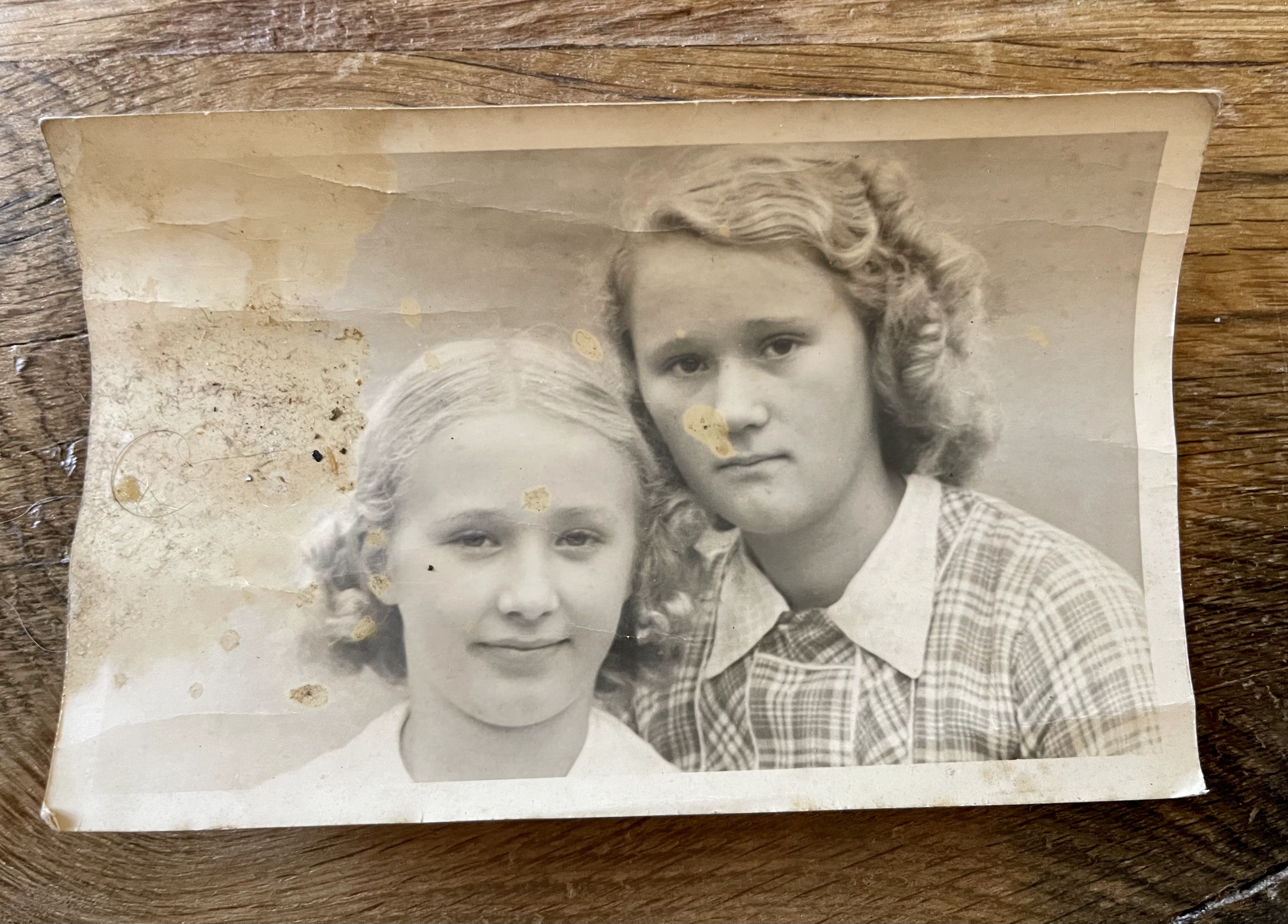
But as is the way here, recycling it meant removing the marble top, separating the lining from its outer casing, checking each section for nails ... And in so doing, discovering a photograph that, decades earlier, someone had taped to the underside of a drawer.  An image of two girls looking into a lens saw its first light of day for lord knows how long.

Who'd put it there I wondered?  The faces suggest they are sisters, but whose daughters or granddaughters might they be? And why paste their picture where it wouldn't be seen?  Are they still with us... or gone now, like the cabinet that housed the fragment of their past?  

I guess we could weave all manner of stories from such flimsy threads. But that's what novelists do, and I'm not one of those. 

So instead I pondered the traces we leave...  

My neighbour is a mason who restores historic buildings — every time I see him at work I'm in awe. Like many craftsmen, he brushes off praise. But if you asked, he'd explain the tradition of mason's marks and how to find 'signatures' in the stone of cathedral walls. His imprint will endure for generations. 

Many years ago my mother wrote a song for her primary school class. One of my earliest memories is her figuring the tune on chime bars at our home. It's since been published in dozens of hymn books and is widely recorded around the world. By the time she dies, how many hundreds of thousands will have sung 'I listen and I listen'?  No doubt, we will play it at her funeral.

And what will I leave?  

Some writing perhaps, at least for as long as it lasts; there are two obscure rock climbs I've given a name to; perhaps someone will keep one of my paintings...  Jane and I like to think that every house we've owned has benefited from our stewardship. With luck, there'll be some inheritance...  

But beyond these tangibilities?

Very little I hope. For legacies are not the purpose of life or indeed the best measure of our contributions. There's value in making a difference now: in helping and healing, in supporting and providing; in simply making ends meet so that those we love can flourish. In an age when we're so driven to 'succeed', some say we should live more in the moment. 

Though by historical standards, we generally do. I read somewhere that very few of us know the forenames of our great grandparents; after three generations we're lost to memory.  That seems to me, no bad thing, for I've always thought the veneration of ancestors to be misplaced. If I could visit any time in history, I'd choose the future, not the past.

As I write the conclusion to this post, I'm struck that my doing so has been delayed. 

Why?  

Because for a week I lost the picture of the girls, absentmindedly putting it down to watch the contrails in the sky across our valley.  Had I not tidied up, it would have curled and faded in the sunlight that streams through the window. Every day here, the planes go back and forth...  a web of slipstreams that momentarily sparkle, then fade to oblivion. 

Saturday, December 4, 2021

Encounters 7 — Vultures

All photos by Justinn Bunn

I first saw vultures when I was twenty-six years old. It was the year that Stephen Roche won the Tour de France and I cycled across the Pyrennes on a tandem with Rebecca. For most of our trip, we carried little more than a change of clothes, our passports and a couple of baguettes stuffed in the saddlebag. We were young, fit, and unphased by challenges I wouldn't look at today.

At the top of the Col d'Aubisque, there's a section of tarmac that's cut into the cliffs, creating a suspended belvedere road with a vertical drop on one side and a distinct absence of barriers between you and the abyss. It's about the worst place I could think of to suffer a puncture or to lose concentration after toiling to the top.  As we rode over the summit, they were circling above us.

And I remember our stopping to watch them, marvelling at the ease with which they rode the thermals, gliding across the valley that had taken us all morning to climb. There's an elegance to the flight of vultures that transcends that of any other bird of prey, and which ironically, in its effortless grace, strengthens our stereotype of the species. 

Vultures, we believe, are cold, calculating, patient...

It was two decades till I saw one again. I know this for I remember the day with photographic clarity. We'd been walking with the boys in the Aravis mountains; it was scorching and we'd taken a route too long and too steep for Jane who was pregnant. That evening when she went to the loo, the bowl filled with blood and her face with tears...

She needed time alone, so I rode my bike up the Col de la Colombière. I wanted it to hurt, pushing every sinew; screaming at the mountains... and their indifference. As I pedalled the last incline—without elegance or grace—there were two Lammergeiers wheeling in the sky. These, the largest of the European vultures, have learned to drop bones onto rocks so they shatter into pieces small enough to swallow. 

They are, I think, the most magnificent of birds.

Lammergeiers are also rare and have only recently returned to the Alps. I learned later that the ones I saw that day were from a reintroduction scheme based in the valley. Three years ago, walking in the Sixt Passy nature reserve, a warden showed me the one breeding nest in the region. The parents did not return while we waited. 

And so, it was almost another twenty years before my next encounter.

This October I made a short visit to France, climbing the Point de Chalune in the crisp autumn sunshine. The peak is a two-hour walk from the top of my favourite cycling col: the l'Encrenaz above Les Gets. We were lucky with the weather: Mont Blanc in full view to the south; Lac le Man to the north. At the summit, two men with binoculars were recording birds for a survey—not that much of interest had appeared, one said. 

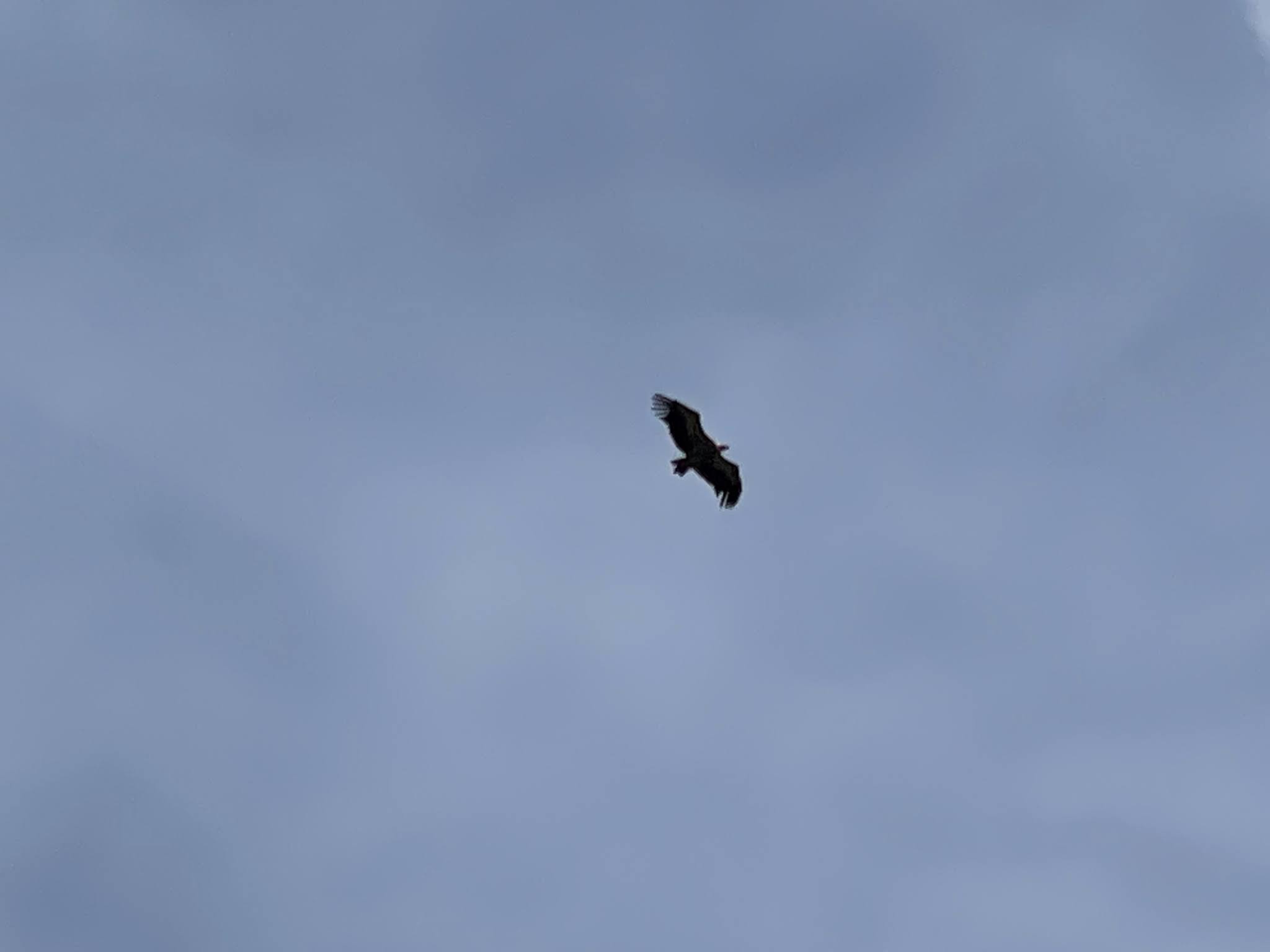
Until that is, he finished his sentence. For no sooner had the recorder sat down than my friend Justin asked, what are those birds approaching us?  There were seven of them in all: five griffon vultures and two enormous Lammergeiers. They drifted above and below us, like a squadron on reconnaissance. The surveyors whooping with delight, furiously taking note of their maturity and size. 

In jest, our new friends credited us with the show, suggesting that vultures liked to smell out the English.  Nous ne sommes pas anglais - nous sommes gallois, we replied, and they laughed. The Welsh, they said, must not be so tasty!  With that, the birds departed, swooping over the valley in the direction of the Désert de Platé.  

And before we'd gathered breath, they were gone.  


Thursday, March 7, 2019

Refuge de Bostan

Westering sun from the Refuge de Bostan  (photo Antonia Chapple)

The questions I’m most often asked about visiting a mountain refuge are entirely predictable. Firstly, there are those who enquire about facilities: can you book a private room; are there flush toilets; do they sell alcohol?  And then there are those who want to know the route, the date and whether they might come along too. Other than an occasional query about the food (usually from veggies) the two enquiries seldom overlap.

I suspect the schism, between caution and enthusiasm, has always been this way.

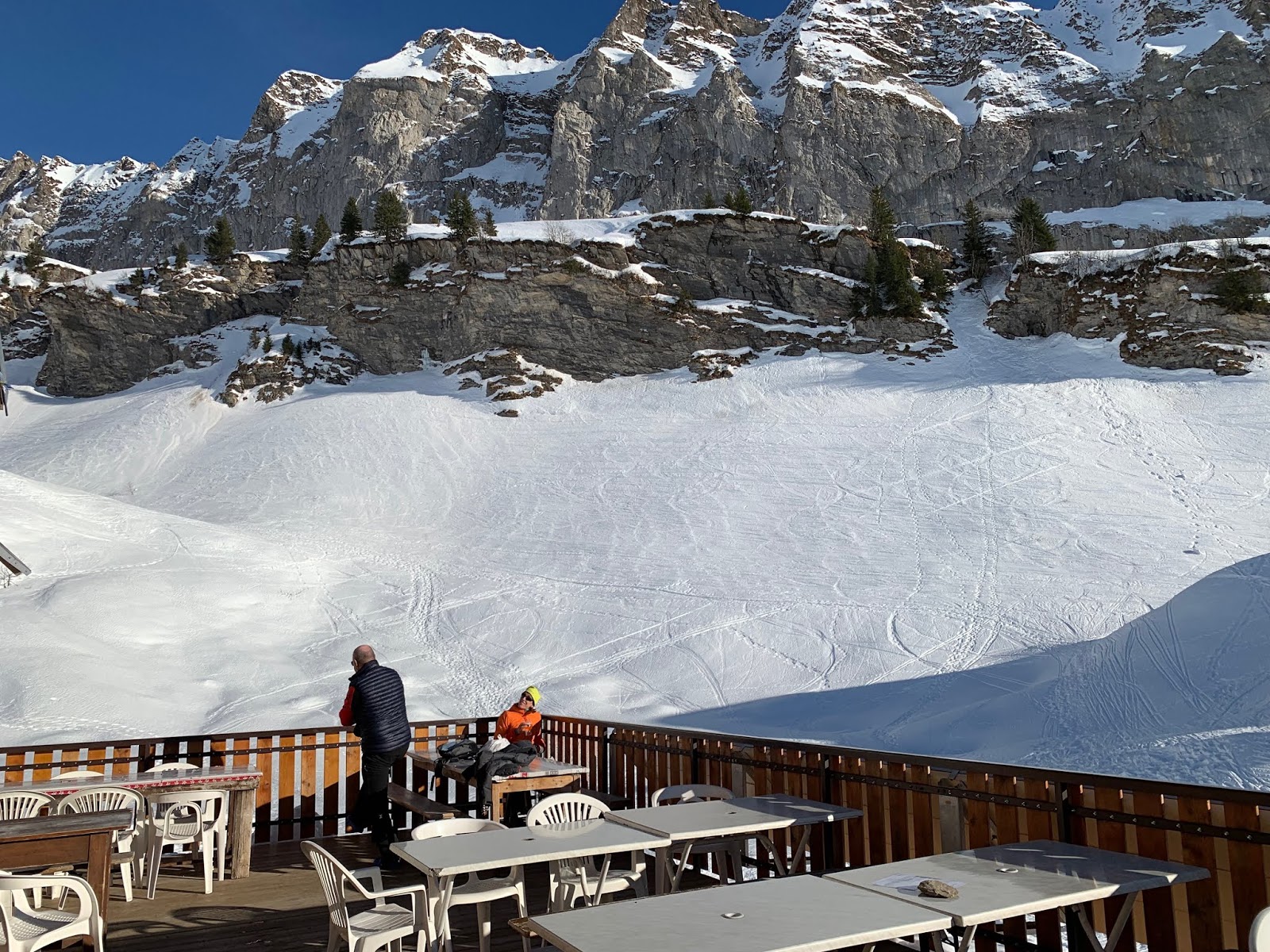
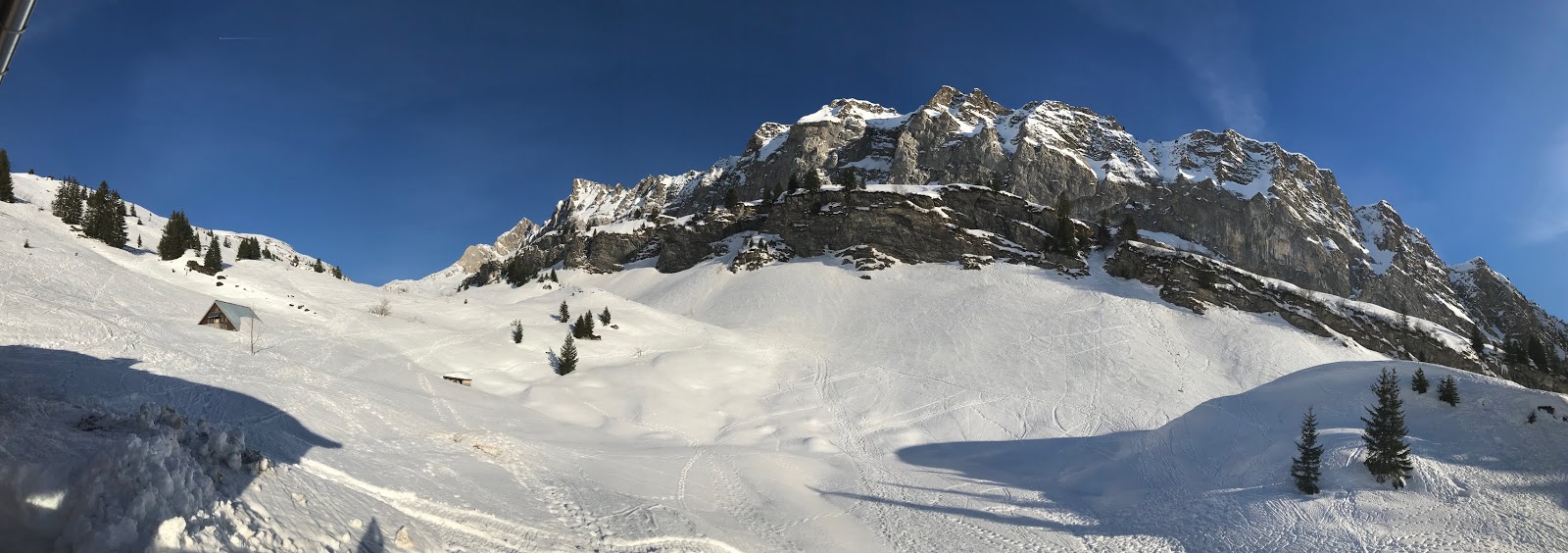
Last week, along with family and friends, I climbed to the refuge de Bostan, above Samoens in the Haute Savoie.  It’s on the GR5 trail so is popular with trekkers in the summer, but also one of the few refuges in the region to open in winter. A visit is often combined with an ascent of the Tete de Bostan; however, on this occasion our ambitions were more focused on camaraderie than challenge.

The most popular route starts in the hamlet of Allemands, from an improbable car park at the upper limit of the snow clearance. It takes a well-marked trail through the Foret de Bostan, before emerging onto open slopes and passing two isolated chalets, from which the way ahead is equally obvious.

Frankly, there’s not a great deal more to say on the route finding; we climbed under cobalt skies but it would be hard to get lost here in all except a white out. The gradient is steady; snowshoes help but are not strictly necessary, the skiers found it easy; all in all, it’s about as stress free as it gets in winter.

But don’t for one moment equate difficulty with interest. To the north, the gentler slopes of the Pass de Golese steepen to the Bostan ridge; opposite, the north face of the Dent’ d’Oddaz casts a gelid shadow on the tightening valley. As we walked the final meters to the refuge an eagle soared above us, momentarily spooking the choughs that were foraging for scraps.

The refuge itself is aesthetically unremarkable, though all things here are relative; at 6,000 feet in a sublime alpine landscape I marvel at who built it; the sheer efforts they must have gone to. There’s a large deck on which we order some refreshments, drinking in the view and waiting the arrival of our second party, who’ve taken a route from the Valley de la Manche to the north.


They arrive smiling, and fourteen of us spend the next two hours chatting, marvelling and air-dropping photos.  We sit and watch the snow redden as the sun dips to the west, the lengthening shadows giving form to icy couloirs, Taking their leave in a tangerine sky, the last of the coughs bicker and wheel on their way to the forest below.


Inside, the refuge has refectory tables, a small bar and a few sofas.  There’s a wood burner, a sink with limited water and few Buddhist prayer flags by way of decoration. It’s Spartan and yet homely enough. Upstairs the dormitories have rows of mattresses, clean duvets and pale lighting to guide in the passages. I opt for a bottom bunk, reckoning it's easier if I need to make the 2.00am hike to the outside loo.

I guess I could tell you more about the meal we had (veggies catered for), the composting toilets or the breakfast next morning – I might even clarify that it costs 45 euros for demi-pension (less for children).  But would any of that be reason to go, or for that matter to give it a miss?

For what’s important – and what will surely stay with us all – is that we laughed and drank and (some of us) snored through the night in an elemental place that’s worth infinitely more than any supposed discomfort.  And I’d defy anyone who’d made the effort not to feel something of the same.

As we walked out the next morning, snowshoes crunching on the frost, I recalled my first night in a refuge. It was forty years ago at the Dresdner Hutte in the Austrian Stubai; the only information we had was three lines in a mountaineering guidebook. It’s still there and yes, you can book a room, there are flush toilets and alcohol is served. The views at 7,500ft are magical, and it's a good base for climbing the Osstlicher Daunkogel too - but if you were more attentive to the facilities than the location, I’d suggest you keep to the valley.


Thursday, March 23, 2017

Reflection and adventure - at the Refuge de Chavanes


Twenty years ago (a little more actually), on plane from Nepal, I had a fleeting encounter that has lodged with me ever since. After kayaking the Kali Gandaki River I was flying home with amoebic dysentery as a souvenir – next to me sat a Nepalese businessman, who in making conversation was curious as to why I should visit a country that could make me so ill?

I remember explaining that Nepal was special, the mountains higher and the rivers more remote than could ever be found in Wales. ‘Then go to the Alps’ he replied, ‘you can have just as grand adventures there!'

I recalled this conversation last week, high in the mountains of the Haute Chablais, as the ridges of the Pointe de Chalune blushed crimson in the embers of the light. That afternoon, a group of us had skied and snow-shoed from the Vallee du Brevon to the remote Chavanes refuge. It sits in the shadow of a glacial cirque, to the south of Les Gets, about an hour from Geneva.

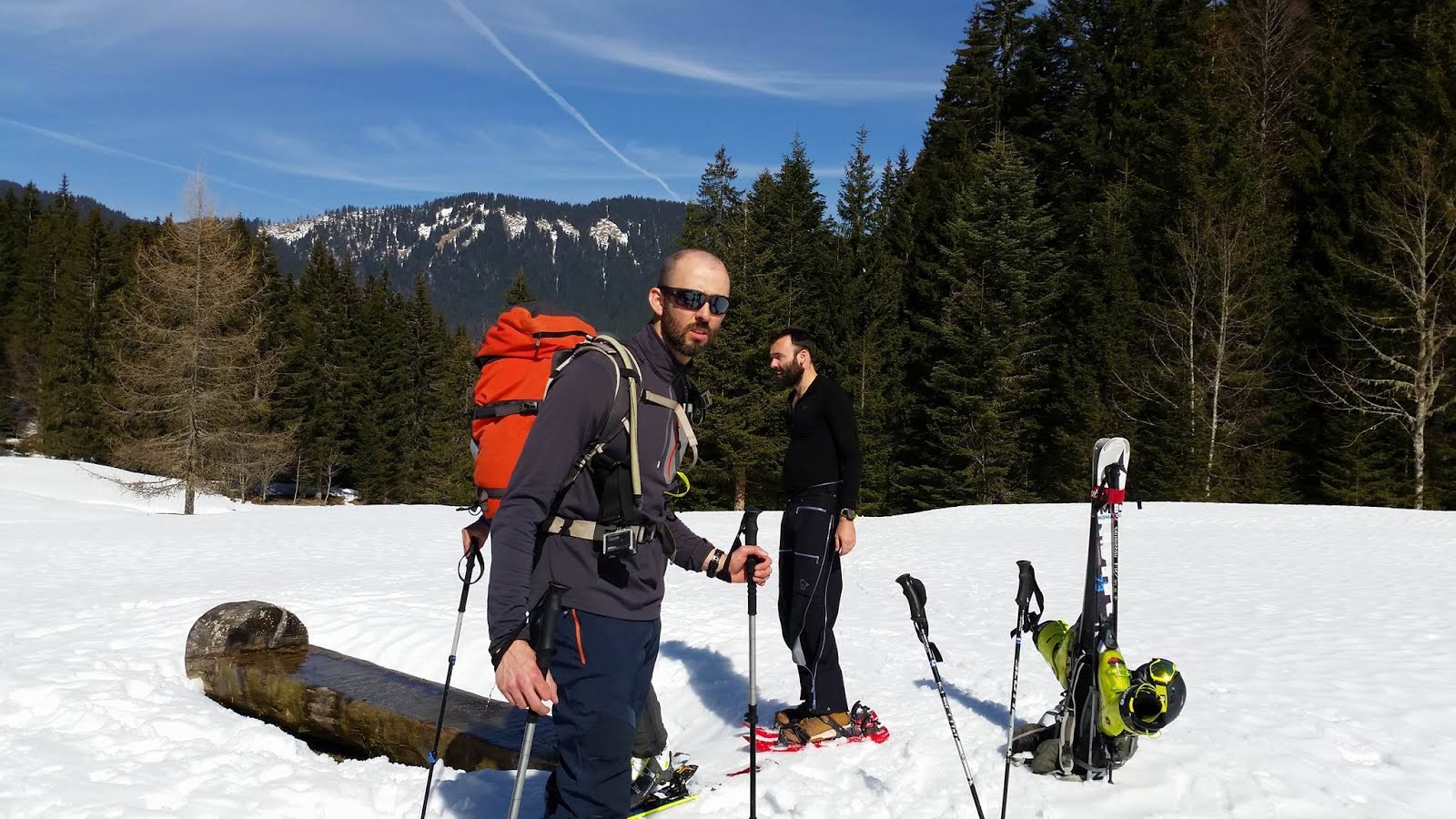
I’d not worn snowshoes before. In a sense, that was an adventure in itself: adjust the heel, strap in toes, check for grip as the baskets flex... At first, I’m glad of my poles, but soon I’m into my stride, scanning for crossbills as we pass beneath pines that are laden with cones. There are tiny spiders scurrying between the fallen needles, and I try to avoid them by shoeing in the rutted snow.

An hour later, we reach an isolated chalet. There is running water and an improbable earth closet for passers by, though the prospect of undressing persuades me it’s easier to pee around the back. We gobble cheese and salami as Simon, who’s been here before (and is ex-navy so can’t help but command), gives us a briefing: it’s steeper from here, there’s ice on the track; be careful towards the top.

Some in the party are using skis, attaching ‘skins’ that resist backward slippage when the ground gets steeper. It looks an odd way to travel, and all the more so in the knowledge of the lifts and gondolas on the other side of the valley. Eddie tells me it’s like fell walking, only with on planks on your feet - he explains that it might look hard work, but there’s a deep satisfaction in making the summit under effort.   As he talked, I remembered the last time I climbed Snowdon; the contrast between the walkers on the summit, and the crowds, making a beeline to the café from the Llanberis train.  

My snowshoes grip well on the steeper ground, they have integral crampons that bite into the ice, and a ‘heel raiser’ which takes pressure of the calves. Though I start in the lead, the others gradually pass me. A year with a dodgy knee has added considerably to my ‘pack’, but overall, I reckon I’m not going too badly for an old man. Leanne, who looks as though she could skin up in half the time, kindly stays to keep me company. She too has travelled widely, but talks eloquently of her love for the Alps, and desire to keep on returning.

Eventually, the trees give way to more open ground, and the final pull is less steep than I’d feared – the others have waited at the rise. We’re in a ring of granite and ice, cradling a bowl of trackless snow; above us are the peaks of the Chavannais, the Chavasse, Chalune and Haute Pointe  Nobody is saying very much.

At the refuge we meet a walking party from Thonon les Bains; they are leaving after what seems to have been a fine lunch. The refuge is owned and manned by Claudius, who, in his visitor books, is variously described as a ‘sage’ and ‘mountain gourmand’.


So perhaps unsurprisingly, we are welcomed with mouse de cider and wine laced with hazelnut syrup. At night he serves us prunes in bacon, followed by chicory salad, pain de campagne, beef bourguignon, a cheese board the size of which I’ve not seen before… and some apricot cake to finish.

And then, there were the wines.

They began with a liqueur de prune, followed by a homemade apricot, some sapin and cassis, and, of course, a little genepi to finish… At one point I counted nine bottles on the table, but it was getting hard to focus.

I’ve been visiting mountain refuges for more than thirty years and the Chavanes is certainly on the rustic side, but its food and ambience are among the best I’ve discovered. The company was a delight too, reminding me that for all I occasionally dream otherwise, I prefer the warmth of friends to the solitude of journeys made alone.

Which, in a roundabout sort of way, brings me back to the man on the plane from Nepal. I long ago came to the conclusion that he was right. I’ve been exploring wild places for all of my adult life, and am fortunate to have easy access to the Alps – but the truth is, we don’t need to go very far, or always to be alone, to find adventure.

The Valley de Brevon is a stone’s throw from the Portes de Soleil, and yet, a million miles from the après ski of Morzine. I could show you places that are much the same in Wales, The Lakes, or Northumberland. Only last month the definitive Scottish Bothy Bible was published – there’s enough inspiration in its pages for a lifetime.


The next morning (after breakfast by Claudius) we descended to the bustle of the valley, and I reflected on the simple, life-affirming, trip we had made together. The Chavanes refuge is, to use an expression coined by the Himalayan explorer Mo Antoine, as wild and as wonderful, as I need to ‘feed my rat’. He meant, by that, to ‘scratch the itch’, to sate his quest for adventure. 

I understand what he meant, and feel privileged to have done something of the same.

Tuesday, August 7, 2012

Alpine memories


I was twelve when I first saw the Alps. It was the 1970s and my parents had booked a package holiday to Interlaken - and in fairness to them, it proved to be one of the most influential weeks of my childhood.  If I rummaged in the attic my souvenirs would still be there: a faux alpine horn, a pennant of the Cantons and a plastic 'view-cam' with images of the Bernese Oberland.

We never returned to Switzerland, but as soon as I was old enough, I caught the train and spent a month visiting Lucerne, the Jungfrau, Lauterbrunnen, Grindelwald... In the thirty years since I've returned more times than I can easily remember. To my boys 'The Alps' is synonymous with holidays - we don't 'do' Spain or Greece, they say, Dad just does France (or occasionally Austria).

Last week we returned to the Haute Savoir, near Morzine. It was where we came for our boys' first trip. This year there were tentative suggestions of going elsewhere - and at Jane's insistence, we'd spent the previous week in the Lorraine region.  Whilst this was a pleasant change, I was all the while itching to get to the mountains.  Arriving at a fabulous chalet on the outskirts of  St Jean d'Aulps, I felt like I'd come home.

Most British visitors go to the Alps in the winter, to ski in the high resorts; an annual fix of adrenaline and biting blue skies. I've only been once - and even that was a freebie - for I don't like skiing, and I like even less what it does to the landscape, though I'm realistic enough to understand that the idyl of an alpine wilderness is long gone. I'm aware too that one of my great loves is cycling, and that's only possible because of the roads and tunnels and engineering masterpieces that are the summer equivalent of lifts and pistes.   

But for me the Alps has become more than just landscape - it is a place intimately tied to memory, to rights of passage, to moments of joy (and occasionally terror) that are milestones in my life. I have a vivid memory of sitting at the Serlesjoch in Austria, aged twenty one, and calculating that if I could spend an annual fortnight in the mountains I'd rack up more than a year by retirement. At the time I dreamed of extreme mountaineering, and over the years I've done my share - of kayaking too - but precious as these memories are, they are only part of a picture. 

Last week was blistering hot; the evenings thick with thunder. One night the valley was engulfed by a storm and my three boys stood on the terrace, 'conducting' the lightning as if they were Gandalf -  daring each other to brave the hailstones and stand, arm erect until the next bolt hit the ground. They were laughing and drenched to the skin, and Jane joined in too as Dylan screamed and delighted in the game. At the end of the week (typical of us) we made a list of our best moments - this one topped the rankings.

I have a hundred memories like this: of bathing our boys in a plastic Sainsbury's box on that first camping trip; of running through a picnic site to catch a Purple Emperor, oblivious to the onlookers who must have been thinking 'whose that nutter with the net'; of Michael, aged ten, pulling ahead as we cycled the Col de Joux Plan, his blue jersey fading to a speck as he rode beyond my reach.

I spent a large part of this holiday playing the role of 'Daddicus', second in rank and general lackey to 'Commander Dylan', the leading character of my youngest son's 'talking game'.  Playing along is a pre-requisite of getting Dylan (who has, shall we say, a limited appreciation of nature) to go walking in the hills. Why do you like best about the game? I asked, expecting a reply about pirates or aliens (for we face a wide variety of enemies).  Being with you, he replied, and I could have melted.

On Friday we visited the Abbey des Aulps, where Jane and I reflected on our week. It was probably our last family holiday she said, a tear welling up. And as I write this paragraph, Daniel has just left the house to take his driving test; next year he'll be at university - we are back to the Internet, to evenings in separate rooms, to friends and girlfriends... 

We were leaving the Abbey when Dylan ran to the crumbling archway, holding his toy sword aloft. Take a photo he cried, striking his best Commander pose. I remembered how three years earlier in that exact spot, he'd made the very same request. As I look at the pictures side by side I wonder if there'll be time and chance for one more in the series. I know that all things must end, but at times like these, I wish not yet... not quite yet.

Thursday, July 26, 2012

Intermarche - and the delights of rural France


This week I’m in France. We’ve hired an old rectory near to Verdun on the Meuse, a stone’s throw from the Great War battlefields. It’s not an area I’d normally choose, but Jane liked the look of the house on the internet, and I‘ve been working on the final draft of my book – we stay in a lot, the boys swim in the pool, and every now and then I add to the list of butterflies I’ve seen in the garden.

One day we made a trip to Bar de Luc, a renaissance town to the south – it was beautiful but deserted; like a Georgio de Chirico painting. Yesterday we visited the war memorials; equally beautiful in their way, though oddly disconcerting as tourist attraction.  It’s been hot – walk only in the shade hot – and to be frank, the landscape is less than inspiring. Every day, what I look forward to most, is our trip to the supermarket.

At home Tesco is a chore – aisles of choice but no inspiration; I shop there in a dash, sticking to the list and finishing before most folks have eaten breakfast. But in France I linger. And not so much at the vegetables, meats or cheeses, as at the house-wares and stationery, the garden equipment and DIY displays – even the Tupperware boxes.

Yesterday Jane found me watching a five-minute video for the ‘Nicer Dicer’, a sort of Mandoline slicer that we decidedly don’t need. There was a smaller version called the ‘Magic Garlic’ that was equally unnecessary, but strangely tempting.  She was getting impatient: What did I fancy for dinner? Do we need any more butter?

I especially like the brushes. They’re different to ours – more like brooms, and they have nifty handles that are better for hanging on pegs. We don’t need any but that’s not the point – we don’t need half the clothes we own - so I put one in the trolley.  It falls out and I reluctantly agree it’s too awkward to transport.

The stationery next catches my eye – there are shelves of cheap exercise books, filled with squared paper (not lined).  This makes them somehow more attractive, almost exotic.  I don’t need any notebooks either, but again I linger – I’m sure I’d write more if only I had some of these.

It’s an oddity of coming to France that I enjoy their supermarkets.  Or is it? Because sometimes it’s in the everyday things that we experience the biggest difference. I once met a couple of German cyclists who’d compiled a list of English eccentricities – driving on the left of the road, salt dispensers with only one hole, front brakes on the right (that’s a cycling thing, but almost everywhere else does it the other way round), unelected House of Lords…

Today is hot again: too hot to go anywhere. My list of butterflies has stalled at the mid-teens and I’m sitting in the shade writing this – if it were not for the heat I could be just about anywhere. Except on my left is a Tupperware box with, I notice, has a rather clever design of lid - and an unusual knife sharpener that was especially effective when I used it last night. Come to think of it, we could do with both of those at home.   

Jane, do you fancy a trip to the Intermarche…?

Sunday, August 23, 2009

Full circle.

The Joux Plan is over the hils on the right
Yesterday I cycled the Col de Joux Plan. The road climbs from Morzine, past the chalets and farms on the lower slopes of the Pic de Nyon, before hairpining through dense pine forests to the summit at 1800 meters. The Col is a regular on the Tour de France, classified as haute category; we once stood on its slopes for six hours to watch Lance Armstrong cruise past us in seconds.
I last rode the Col with Michael, my middle son and a precociously talented cyclist. I remember advising him on his climbing technique, reminding him to save his energy, to drink and to eat regularly. He paid little regard, and as the road steepened, he gradually pulled away. All my experience counted for nothing against this slim boy, cruising each harpin with effortless grace. By the time I reached the top he'd been resting for fifteen minutes.
I took a photo of him by the summit plaque before we began the descent (I have a copy on my office wall). 'Be careful,' I warned him, 'and don't go too far ahead.' He didn't want to listen; he was sick of me telling him how to ride, he said - he wanted to do it his way.
And I remember, as I watched his blue jersey streak ahead, being suddenly overwhelmed with fear. Not of him crashing - he was too good a rider to worry about that - but of losing him. Quite to what I was losing him, I didn't know. But I was desperate to catch him; descending as fast as I dared, each turn more reckless than the next - and all the while the wind drying my eyes. 'Not yet,' I kept telling myself, 'Not quite yet...'
That was three years ago. Michael raced over forty times that summer and only once came second; by the end of the season he topped the national rankings. Cycling was a huge part of our lives then, but from that day onward he increasingly rode on his own terms. He's more relaxed now, and interested in other things besides bikes, (a good thing too) but he remains a wonderful rider.
Climbing the Col yesterday we rode our mountain bikes; big lumbering things, not suited for taking hairpins with effortless grace. I am fitter too and could stay with him longer; he grumbled about the heat, which made me smile. But by the second half of the climb he had pulled away. Groups of tanned riders passed me with ease, but I watched them stamping on their pedals to catch the young boy up the road. For despite his talent, and the three summers since we rode here, he is still a young boy in body and at heart.
I reached the summit only five minutes behind - progress of sorts. No photos this time; he dropped over the lip and within seconds was two hairpins ahead. No risk taking too; I'd go down at my own pace.
He was waiting for me at the half-way chalet. I snatched at my brakes and almost skidded off the road. 'Are you all right?' he asked, passing me a water bottle and a handful of Haribo.
'I'm fine,' I replied. 'Just doing it my way.'
'That's cool,' he said. 'For a moment, I was worried I'd lost you.'

Wednesday, August 19, 2009

Off to France

Sawn tree. M Charlton circa 2004
Tomorrow, I'm off to France for ten days, so you won't hear from me for a while.
I've been neglecting the blog for the last week or so. Pressure of work I'm afraid, though fellow blogger Sara, has been a star (she helps me through her company, Watershed PR) She also remembered my birthday - so thank you for the book Sara.
I'll not tell you about the present Jane bought me because it will spoil a good blog post, and as it doesn't arrive till I return, I can't photograph it yet - but boy, was I pleased.
In the meantime, here's some old paintings I rediscovered the other week.
Detail of 'Don't touch the window' M Charlton 2002