Showing posts with label Objects of life. Show all posts

Sunday, January 2, 2022

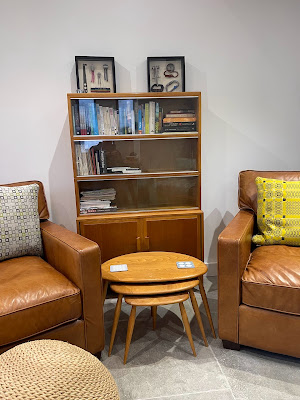
Objects of life #8 — mid century bookcase.


Yesterday, on the turn of the year, I decided to tidy our back room. It's one of those awkward spaces,  useful and yet not quite what it could be; a thoroughfare from the front to rear gardens that we use for coats and boots and anything that might make the cottage look untidy. When I bought this place it was no more than an earthen floored shed; decades earlier it had been used to keep pigs. 

None of which is particularly relevant, except for the process of relooking and sorting —the putting of our lives in order and hoping they might stay that way; which of course they won't. 

But that doesn't mean we shouldn't have the patience to try.

In the corner of the room was a mid-century bookcase that I bought when I was twenty-one years old for my first ever house. I'd seen it for sale in a newspaper small ad of the type that nobody bothers with these days. And I remember the elderly lady who sold it to me: she was small and solid with deep-dyed hair and bright features that hinted at the beauty in her youth. She was almost seductive and insisted on my having tea and offering me a small table she was selling too. For years it was in our summerhouse until (to my deep regret and in a moment of unthinking) I disposed of it as clutter.

Why do I remember that encounter so vividly?  And why do I recall it so often? I must have forgotten a thousand equivalent meetings, and yet, I could show you where her flat was in Cullercoats, overlooking the sea in the north east of England. I could tell you with confidence that the bookcase cost me fifteen pounds and that I gave her an extra two for the small table. If I took a moment I'm sure I could bring to mind the smell of her perfume. It seems our minds hold onto memories as randomly as we do the objects we own.

And as I get older, the two become almost indivisible.

The bookcase has been with me in all my houses since that day, even if, like the space between our gardens, it's not always been fully utilised or appreciated. For the last year, it's been squeezed lengthways between a wall and a wardrobe that stores our coats; when we pulled it out yesterday, its shelves were crammed with a plethora of 'stuff' that hadn't quite got another home. Someone in a more objective mood would've taken the lot to the tip.

But then, they wouldn't have been looking closely. For despite its utilitarian appearance, the cabinetry is precise and cleverly designed. To help its movement and assembly, the shelving dismantles and fits together with a jigsaw-like accuracy; the panels are subtly coloured, the hinges smooth, the doors satisfyingly snug. It would be easy to mistake the workmanship as coming from a famous maker like Ercol or G-plan, but in fact, it's anonymous. Which I rather like, as it avoids the temptation to put a price on something whose value isn't about money at all.

That said, I'm told that mid-century furniture is enjoying something of a renaissance. It seems my taste of forty years ago is finally becoming trendy. As we dusted it down and cleaned the glass my teenage son said,  I guess this is going in your fancy new study?  And he was right; it fits perfectly too — between the chairs where I like to read and the pebble tables which though an iconic design irritate me a little with their fiddliness.  Oh, I do so wish I had that table I threw away. 

Coming to my study this morning I had no intention of writing about this. But then yesterday I had no idea that the bookcase would find its home and feel so appropriate at last. It's as if the sorting of objects helps to clear our minds too, suggesting possibilities and settling ideas into place — not dissimilar, perhaps, to the way we store books on shelves; an ordering of our memories, of significant moments... the putting of our lives on display.

Saturday, March 20, 2021

Objects of life #7 - Stick

Junior walking stick from Hawes

I grew up in the North East of England at a time when family holidays seldom amounted to more than one week a year. We spent ours at towns and resorts which today would seem little further away than a day trip destination.  One year we travelled to Whitby, another to Edinburgh, and once to Berwick on Tweed. There was a trip to Keswick too, which my father, in one of his bouts of depression, refused at the last minute to go on— my Mum took me and my brothers regardless, travelling by bus and train, then walking up hills every day to tire us out.

In some ways it's not surprising that my father didn't come, because mostly he hated holidays—only later in the Seventies when he could lie on a beach in the Spanish sun that he was ever happy to leave home.  Whether that was because of his depression or his inherent demeanour I don't know, but I do remember the rows just to get him to go for a picnic. When my mother learned to drive, she at last found the freedom that would convince her to leave for good.

But the exception to this rather gloomy beginning for a blog post were our visits to Hawes in the Yorkshire Dales. My father had been an evacuee there—arriving as a family unit with his brother and my grandmother; presumably, my grandfather was enlisted at the time. They lodged in a manor on the edge of the town and at some point moved to a farm across the fields from what later became the Wensleydale Creamery.

On our first visit my father took us to the 'large house', and I remember we were all peering over the wall into a bramble filled garden when a voice shrieked. 'Are you looking at my wilderness!' Leaning out of the upstairs window was what I took to be a witch with long ragged hair, tattered clothes and boney arms—very much the 'lady in the attic' look. Which turned out to be not so far off the mark...

After explanations and introductions, we were invited in for tea. The present owner was, to use a phrase of the time, completely barking! The house was a ramshackle ruin of peeling paper, broken china, and musty chairs. She claimed to keep her husband upstairs in a cupboard, which I was later told not to take too literally, but never quite shook the suspicion of its truth.  Whenever we passed by my father would tell stories of the times he'd spent there and in the area.

Looking back, there were few places that my father enthused over as much as the Yorkshire Dales. I sometimes wonder if the reason for this was that his own father was away for the time he was there?  My grandfather was a uniquely wonderful man, but I'm under no illusion that he wasn't always the best or most present of dads.  There was a bond between my father and his mother that I sense came from those years and was associated in his mind to the places they'd stayed.

He took us often to the nearby village of Gayle and a brook he called Belia Banks which I can't find on the map and may be spelling incorrectly, but it's where we went looking for—and caught—crayfish. We also went to Aysgarth Falls and the Buttertubs Pass and the cheese factory; in the town we visited a ropemaker and nearby a chap who made clogs, from whom my mother bought a miniature pair which sat for years on our hearth at home... 

And somewhere in all of this, I acquired a walking stick, of the size suitable for an eight-year-old boy.

That stick is the second oldest object I have from my childhood. Beating it by a few years is a French faience bowl, but as that has sat in the china cupboard and storage boxes for much of the last fifty years it doesn't carry the same store of memories.  In truth,  because it's so small I've not been able to use the stick for most of those years either— but always I treasured it, and my sons have played with it and somehow it's never not been 'around'. Currently it lives in an umbrella stand by the coat rack.

Before writing this post I took the time to look at it again, examining the knots and burrs, the careful bending of the wood to shape the handle. It's probably made from hazel or ash and has a brass ferrule that rattles because the shaft has shrunk—there's a tiny split near the base of the cane which I hope can be repaired. At one time it was varnished, but only remnants remain, the years of wear and rough play removing all but a few flecks here and there. 

But you know, there's only much you can say about a stick—or indeed, that needs to be said.  Because it's not so much the thing in and of itself that's important. It's the connection it holds to those holidays: to the times we stayed at the farm B&B and drank goat's milk, and chased the geese over the field each morning, me waving my stick to drive them.. and to the names and places that are with me still, and to the memory of my father for once not hating it quite so much.

It has just occurred to me now that when our first son was born, Jane and I took him with us to Hawes for a holiday that summer. We carried him in a backpack on our walks: to Gayle and the Buttertubs Pass, to Aysgarth Falls and the ropemaker in town...  I'm sure we must have been to a stick maker too... and certainly, we bought some cheese from the creamery,  and looked for the large house and saw the fields of geese... 

Oh, how life—and our lives—turn in circles...

Sunday, March 14, 2021

Objects of life #6 Puzzle

A puzzle resolved?

You should bring an object with a strong emotional connection, said the preparatory notes to a writing class I attended last week. If you can't have it to hand, then one you can hold in your mind's eye; something you can feel, in every sense of the word. Had it not been an online class, I might have prepared more fully—instead, I reached instinctively to the drawers of my desk where the puzzle resides.

As it has for more than forty years.  

I'm not exactly sure when I acquired it, but it must have been around my early teens—and it was a Christmas present, I know that. Or at least I do in the sense that it's my fixed, if often fallible, memory, rather than in any evidential proof: the puzzle isn't the sort of item you'd be holding in a photograph, and as it's spent most of the last five decades in the dark it hasn't even faded with age.

Describe your object, the tutor said: square, smart, controlled—circles and hoops—patterns and archways— click, rattle roll...  And then the emotions it holds, she continued...

Anyone who's attended a writing workshop will recognise these sorts of exercises. I'm not very good at them—the speed at which we're expected to respond is too quick for my liking. Often, to be honest, they're a bit 'touchy feely'—and there's always, lurking in my mind, the fear of what I call the curse of the workshop genre: snippets that are seldom as deep as we believe at the time.

Yet, when I look back at my notes, I'm struck by the viscerality of what's on the page: I love it actually,  I love it a lot—a little square box of my childhood—controlled, calm—better and different to others—the 'winning position', it says on the back...

Apt!

I don't know what forces drove me to write that, and to underline it too. 

The puzzle was merely a stocking present—I doubt anyone else in my family would remember it, or knew how much I liked it at the time. It's a solid little item, and as a young boy it felt like I owned something rather sophisticated. I was good at solving it too—skilled at the deft nudges and delicate balance it requires. At that age, I used to nurture the idea of everything being controlled and ordered, of having a desk, and an office... and handwriting that was neater than my father's...  

How odd is that?

The person I feared most in the world, controlled through a plastic puzzle? Is that what psychologists—psychiatrists even—might say of my holding onto it? For all they might, I wasn't conscious of that then, nor have I been all these years. The puzzle is just a present that felt smart (a word I used repeatedly in my notes) and which by some random happenstance I never threw out... 

And so it's stayed with me through college and jobs and houses and children... all the hoops and circles of my life and the lives that have mattered to me. Is it possible that sometimes the objects we hold onto have meaning simply because we've done just that? That their significance grows in direct proportion to their age—as if by discarding them we would be forsaking our past? 

The artist Michael Landy has long fascinated me—in a performance piece titled Break Down he famously destroyed every object he owned, including his passport and keys. The shredding of a painting by Gary Hume, a fellow Young British Artist, was a talking point at the time. But it was the destruction of his childhood toys, and his father's sheepskin coat, that brought me close to tears. It has always struck me as unspeakably brave.  

I sometimes wonder what will happen to the objects around me when I'm dead. Any significance attached to the puzzle rests with me, not those who will sort through my drawers. Most likely, they'll find some items of sentimental value—but who wants a collection of moths, or the detritus of a life that's run its course? I wouldn't want that from my forefathers.

That said, there are a few small heirlooms I keep; my grandfather's prayer book; a golden cravat pin; a clip that's shaped like a fish. Will the next generation—or the one which follows— care, or even know of their heritage?  Entropy must always increase with time.

We know that objects can only ever be a proxy for a past that must eventually be lost. We know too, that real life isn't like my puzzle—that it's not controlled, or always smart, or never fading with age... and that any so-called winning position—no matter how deftly nudged or delicately balanced—cannot be held indefinitely. The square box that sits on my desk is waiting to be shaken once more; to be re-solved (resolved?) in a way that's necessarily different to what went before.

It's a puzzle. 

But I love it—I love it a lot—and I can hold it in my hand as well as my mind's eye. 

A good choice for the class, after all.

Saturday, February 27, 2021

Objects of life #5 - TAG Heuer watch

TAG Heuer Formula 2000 watch

It's a sign of age to have a receipt box that's overflowing - indeed, it's probably a sign of age to have one at all. These days most invoices are electronic, but I still keep the habit of filing the paperwork for those items I perceive to be of value. This morning, I spent a pleasant half-hour rooting through the records for bikes I bought thirty years ago, jewellery that's even older, and paintings from a lifetime of collecting. 

But try as I might, I couldn't find the receipt for my TAG Heuer watch. I know I bought it sometime in the late Eighties, the first (and only) expensive one I've ever purchased. From memory, it cost me about a thousand pounds, but I think that must be wrong, which was why I was checking the file. It seems too much to have paid - a lot of spare cash for the time - I'd not buy a watch for that now?

And yet, for the last ten years it's languished in a drawer.  The face has tarnished so the battery must have leaked; the diving bevel no longer turns and the strap could do with an extra link or two. All in all, it's in a rather sorry state. Which is a pity for an item that hold memories much richer than any receipt could record.

TAG Heuer watches were once all the rage among kayakers. Mine came with me on expeditions to Nepal (twice), Turkey and several trips to the Alps. It's been down more rivers and across more stretches of sea than any boat I've owned.  I wore it when I was married and as a surprise wedding gift bought Jane a matching one that she still wears today. 

I wonder if there's any other object that accompanies us as much as the watches we wear? A wedding ring perhaps, but they're essentially passive - whereas a watch is something we use, a party to the decisions we take. How many times did I check the face of my TAG Heuer; how many choices did I confirm - or cancel - on the turning of its hands?  How much water did it witness flowing under the bridge of my life?

The model I have is a Formula 2000, which reflects TAG Heuer's sporting image. The company has been an official timekeeper at events dating back to the 1920 Olympics;  they're a sponsor today of sports as diverse as football, sailing and athletics. It's all nonsense of course - part of their lifestyle branding - for in practice, any digital watch is more than accurate enough, and I doubt there's an athlete (or a kayaker) who'd still use a model like mine.

But precision's not the point anymore, just as it never really was. Watches - and certainly ones of this sort - have always been about more than utility. For many, they're a form of conspicuous consumption, as anyone who's passed through the arrivals hall at Geneva airport will understand. For others, they're about fashion and style, a statement of who we are - or more likely, who we'd like to be.

The strange this is, none of this has ever appealed to me. We need to be careful in assessing ourselves, but I reckon I don't risk a hostage to fortune if I say that I'm not a brash or bling person - nor for that matter a style guru. And as for sporting prowess, what little there was is now as dormant as my watch this last decade.  

Which makes me think, it's about time I recharged the batteries. Coming to the end of this interminable standstill, there's something pleasing about the idea of its hands turning once more.  Wearing it would be a symbol of new beginnings and times gone by - a reminder that all our days are precious.

So I'm going to send it to a specialist repairer. No doubt the cost will be more than's sensible, but maybe that's fitting. For its value lies not in money but in memories - and in the making of new ones. And that's an asset that takes time to grow.

Sunday, June 28, 2020

Objects of life #5 - Butterfly Bush


Buddleja Davidii
Buddleja Davidii, today in my garden

The butterfly bush in my garden is the latest in a lineage of sorts. Specifically, it's a Buddleja Davidii which originates in Central China but is named after the French naturalist and missionary, Armand David.  Like many of our garden shrubs that are technically non-native, it's found a genial and generally welcome home in the UK, often thriving in a feral fashion, like it does on the disused railway line not far from here.

As the common name suggests it was my interest in entomology that first made me aware of the Buddleja. Certainly, it's the only shrub I could have named as a youngster - and taken you to every garden which had one in the crescents and avenues that were the heft of my childhood wanderings. The largest, on Burnside Road, had white flowers which caught the afternoon sun and where, one July after school, I first saw a Painted Lady. Its sighting is marked in a copy of the Observers Book of Butterflies that I still keep by my desk. Only last week I saw a Marbled White and made a similar pencilled note in the margin. 

Almost every house I've lived in since has had a Buddleja. The one in my current garden came from a cutting given to me by my mother - it was meant for our place in France but try as I might they won't take there. So I planted it here in the worst of soils and in three years it's grown above head height. My last home had one so big it was effectively a tree - in many ways, it was why I bought the place -  and yet as events turned out, our time there coincided with some of the wettest summers on record so the list of species it attracted is more paltry than I'd hoped.

In the Alps, the unkempt bushes on the verges and riversides are festooned with species that would have made my teenage eyes alight: fritillaries, gliders, graylings, even swallowtails and the occasional Purple Emperor are all regular sightings. Back in Wales, the list may be less extensive but I'm equally delighted with a Peacock or a Tortoiseshell - each as beautiful as any species I've seen in fifty years of looking.

My latest bush came into bloom this week and yesterday our new puppy was sniffing and sneezing at its flowers. Which reminded me that the fragrance is not for our pleasure, but has a different and more practical purpose. Look closely at a Buddleja on a sultry evening - or even better with a torch after dark - and you'll be inducted into the fabulous and fascinating world of moths. Unlike butterflies, which have only 57 UK species, there are more than 2.500 of their nocturnal cousins. If common naming were more democratic - and lyrical - the Buddleja should really be l'arbuste de papillons de nuit, as they'd say across the channel.

Years ago, when our elder boys were small we hired a chalet near Annecy for the summer.  The patio terrace had a Buddleja to its side and every evening around seven the hummingbird hawk moths would hover over the flower heads, dipping their long probosci into the nectar.  We'd eat our dinner to the hum of their wing beats, Daniel marvelling at the speed and dexterity of their flight.  Later, as the sun dipped, the other moths would arrive to feed in numbers too great to count or label.

I learned recently that the species name 'Buddleja' was bestowed in honour of the Reverend Adam Buddle, another cleric and naturalist - like Armand David -  who compiled a complete English Flora early in the eighteenth century. It's ironic that the Buddleja Davidii would not have been on his list. And yet, in its binomial naming, there's a connection between the UK and France which I like to think in some small imaginative way my attention to these commonplace shrubs pays homage to still. 

The bush in my garden will flower for perhaps a month, longer if I dead-head the stems. A friend who knows about these things tells me the blossom would be bigger if I pruned it next spring, but I doubt I shall. For I'd prefer to let its branches spread, and like me, in the years since I stood in the shade of those white blooms on Burnside Road, find their own ways to the sun.

Sunday, September 1, 2019

Objects of life #4 - Haston Vallot rucksack

Karrimor Haston Vallot Rucksack
Unless you're a mountaineer - and even then, you'd have to be one of a certain age -  I very much doubt you could name, let alone recognise the significance of, the rucksack in the picture above. For most folk it would be something that's stored in the loft, deprived of light until tipped or car-booted for few quid at best. And yet, in its time, the Haston Vallot was quite the thing, as was the climber, after whom it's named.

I bought mine in June 1980, at the start of the long summer break from university. My parents had recently separated: my mother moving to a tiny flat; my father not really an option to stay with. With nowhere to else go, and some inspiration from the Backpacker's Handbook, I decided to walk from Coast to Coast. And so began a path that, in a sense, I'm following still.

The man in the shop said it was definitely the one to buy. I remember being sceptical: it was expensive, and most rucksacks in those days had metal frames and multiple pockets. This was different, he explained, an alpiniste style which didn't use a structured chassis - the hip belt and straps would do the work, and what's more, if I progressed from walking to climbing, I'd already have the right equipment...

Ten minutes later and I owned my first piece of mountaineering gear.  I bought a sleeping mat too - and a Trangia stove that's still going strong. Somewhera along the way I acquired a tent and sleeping bag; they weighed a tonne, but they saw me from Whitehaven to Robin Hood's bay and afterwards most of the Pennine Way.

In the late Seventies, Karrimor was the UK's leading rucksack brand. They were known for good quality, innovative designs. The model I bought was named after Dougal Haston, the first Britain to succeed on the direct route of the Eiger's north face. His bold style was an inspiration for a generation of mountaineers pioneering alpine style ascents in the Himalaya and beyond. My memory tells me that he designed the outer loop which stows the belt and stops it from snagging if you haul the pack up a cliff - but I can't be sure and suspect I'm getting a bit geeky... What's more relevant is that by the early Eighties all packs looked a little like this, and the sacks we use today owe their heritage to these early designs.

Austria 1983
Returning to my purchase, after that first summer it transitioned with me from walking to climbing, just as the salesman said.  I took it to the Alps, on hut tours in Austria, and for years it carried my rock gear round the crags of Northumberland. It's a regular presence in my photo albums of those years - like a hidden clue, of the sort a TV detective would spot.

And if they ever came looking, they'd not take long to find it - for I never got round to storing my sack in the loft.  In fact, I used it this week to go camping with my eldest son, retracing a walk over the Preseli Hills that we'd first made eleven years ago. He was a teenager then, and the story of that trip became the title piece of my book Counting Steps. It seemed appropriate for our return, though my nostalgic mumblings cut little ice as I fumbled with stiff zips and broken buckles - but that's another story, for another book maybe.

Sadly, Karrimor are no longer in business - they went bust in 2003, though the trademark limps after purchase by Sports Direct. Dougal Haston is gone too; he died skiing in Leysin, not far as it happens from my house in France. But I reckon my old sack has a few years in it yet - there's evidently a repair shop in Lancashire that can sort those zips, and despite the odd creaky joint, I can still smile as I shoulder the weight - and the memories - it holds.

Summit of Mount Serles, Stubai Alps

Monday, May 29, 2017

Objects of life #3, monocular 8x30, 8011162


Two days ago, at the summit of Pen y Fan, I reached into my rucksack and took out a small leather pouch. Inside was an old Russian monocular which magnifies at a paltry 8x30; the lens was dirty and the focusing wheel so stiff it required two hands to turn. I've no certainty of the make (Zenith possibly?) but its serial number is 8011162, and oddly, I've known that by heart for thirty seven years.

I bought the monocular when I was coming up nineteen. It was my first summer as a student and, in between signing on, I spent it backpacking the long distance paths of Northern England. I couldn't afford a proper case so made the pouch myself, hand stitching the brass zip into the mock suede fabric. That long July and August it came with me on Hadrian's Wall, the Pennine Way, and from coast to coast.  

Monoculars were rare back then - they're hardly commonplace now, but this was pre-internet and I remember being delighted to find one in a second-hand camera shop. I think it cost me about £8.00. The reasons for buying a monocular were two-fold: firstly, they were recommended as a weight saving tip by the Backpacker's Handbook; more importantly, I have only one eye that focuses, so binoculars are of limited use.

After that summer I used the monocular less frequently, and more recently it has gathered dust, surpassed by a newer model that offers better light capture and magnification. Jane considers the original to be useless - she says if reason had its way, I'd have sent it to the junk shop years ago. And she'd be right - if that is, our possessions were all and only about utility.  Instead, it has stayed in my desk, beside the pens and brushes and old sketchbooks that hold memories beyond any logical worth.

Recently, I had my eyes tested.  I've used reading glasses for a decade, but two years ago I noticed my distance vision was weakening too. My optician gave me specs for driving and I found myself turning to them more and more. This time round, I asked if I could wear a contact lens instead - and it turns out I can.

Three weeks later and I'm still pinching myself when I look at the landscape!  It's not just the extra clarity; by correcting a slight astigmatism the new lens widens my peripheral vision, and with only one functioning eye, that makes for a massive improvement. The other day I compared it to the difference between an analogue TV, and a 50-inch widescreen with High Definition!

But if there's a downside to wearing the contact lens, it's that my reading glasses are now too strong. My optician suggested I buy some cheap readers. You won't need expensive lenses, because the contact will already have corrected the shape of your eye. You might find your old glasses work well - if you still have them that is. 

And that's how I found myself sitting at the top of Pen-y-Fan, holding my old monocular to a newly lensed eye, watching the walkers on the ridge. The view, like memory, was blurred at first - but after a while, it came into focus. A group of young people were nearing the plateau, most of them wearing university hoodies.

As I was readying to go, they asked me to take their photo and to, my surprise, a girl passed me a camera rather than a phone. You need to press the button quite hard, she explained. After handing it back, she must have sensed my thoughts.  I know it looks a bit rubbish, she apologised,  but I've had it for years and it still takes good pictures. 

Sticks in each hand, I smiled as walked down the hill.


Saturday, February 6, 2016

Objects of life #2, Windsor chair


As I sit and type this post my arse is getting cold, and somewhat numb too. The chair it's attached to (save for a thin layer of cotton) is a Windsor stick back, made of oak, by someone a long time ago.  If I turned it over I could show you the marks where they've drilled and chiselled, so the legs butt neatly in the slab.

I found this chair almost thirty years ago, in a shop in Monmouth, shortly after coming to Wales. It was one of those impulse purchases - saw it; loved it; bought it, all in five minutes - and at £190 it seemed a lot of money at the time. I remember too that it caused a row because my wife was annoyed I'd not asked her first.  It's my money I'd said; and it's our house, she'd replied - to be fair, she had a point.

It was always my chair after that, and when we parted it came with me too. There are few days since that I haven't settled in its frame to ponder or write. A while back, my company insisted on supplying me with an orthopaedic monstrosity, complete with lumbar support and variable height adjusters  - it soon adorned my shed, before making its way to the tip.

Sick chairs are traditional, vernacular furniture - they were common throughout the UK, but particularly so in Wales. Experts can identify the region of origin, sometimes the maker, and ironically, for what started as humble country effects, they're now sought after antiques with provenance and prices to match. Some of the designs (Windsors particularly) have been adopted by manufacturers, and you'll find any number of reproductions on eBay.

But despite the mass producers, stick chairs are still made by craftsmen today. The twentieth century guru was John Brown, who published a definitive book on styles and method. His chairs are objects of beauty; among the few things I truly covet. There are contemporary makers too - so it's a craft that lives on, though more for sales than for personal use.

By today's prices, my £190 wasn't a bad investment. More importantly, it's given me thirty years of pleasure and memory. The surface of my chair is pitted with history, a palimpsest of my time in Wales. That's the character of the possessions we care for - objectively, they are 'worth' this or that - but what's the value of the wear on the arms,  or the chips in the varnish where my sons played with their toys?

As I finish this post I can barely feel my backside.  I ought to get a cushion; probably will - but regardless, I wouldn't want to have plonked it anywhere else.

Sunday, December 27, 2015

Objects of life #1, faience bowl


Somewhere, among the stacked assemblage of boxes in my new garage, is a small faience bowl, marked (allowing for incorrect spelling) with my Christian name, and given to me as a gift when I was two years old.  My Great Aunt, on a tour of Europe and trip home from Australia, brought one for me and another for my elder brother.

I don't remember her visit, but I know I must have been a toddler because my younger brother hadn't yet arrived. This explained why, for all my childhood, only two bowls were displayed in the drawing room cabinet. And why also, when peering through the glass, I felt such great fortune that I was born in the nick of time to be given this valuable and mysterious treasure...

Such are the delusions of youth.

Quite why I still have the bowl, is part mystery too. Most probably I asked my mother for it during one of her clear outs or house moves, but in truth, I can't remember. Whatever, it has been with me for thirty years and a half-dozen moves of my own. As far as I'm aware, it's the object that I've owned longer than any other.

The odd thing, in my keeping it, is that I otherwise dislike French faience. The designs remind me of the worst on offer in craft fairs, and the figurative illustrations have a Protestant dourness, despite their gaudy colours. Even to describe the bowl as faience is probably incorrect.  My Aunt had certainly travelled through Brittany, and perhaps visited the famous Quimper potteries, but the bowl is not stamped with their mark - souvenir stall trinket is more its likely provenance.


Perhaps that is why I make an exception for this particular example - it could sit as comfortably among my collection of kitsch as it did in my parent's china cabinet. Though paradoxically, I am still reluctant to use it, for fear of chipping an edge.

And it seems to me that our lives are a little like that. We surround ourselves with friends and objects that aren't rationally chosen or related to; but rather, they're a mash-up of chance and situation and memory (usually flawed) - and sometimes just a plain persistence of presence.

The objects we chose to treasure, perhaps because they don't change while we do, acquire a value which transcends objectivity - they root and remind us of where we are from and, in a curious way, help us adapt to the new. They become as much a part of ourselves and our sense of belonging as are the towns and houses we chose to call home.

Which perhaps explains, why the top of my list of New Year jobs, is a note to unpack those boxes in the garage.