Monday, June 1, 2026

Why I’m no longer learning Welsh.

It’s nearly forty years since I first moved to Wales, so I’ve decided it’s time I stopped learning Welsh. This doesn’t mean I’m giving up on the language – indeed, rather the opposite, for I’ve spoken more Cymraeg in the last month than the previous four decades. If you haven’t yet twigged, the operative word in the sentence above is ‘spoken’!

And that’s because I’ve realised that all the books and grammar tables and YouTube tutorials can only take you so far. In my case, they do worse and fry my brain as I try to decipher and translate in a literal way. Which of course is not how things are, or how we make progress, in the real world.

Instead, I’ve taken to simply speaking out loud, and seeking every opportunity to give it a go, make mistakes and try again… The ladies who run my local café laugh that I speak Welsh with a bit of French thrown in – but they are so welcoming and delighted that I try. It turns out I also have friend in the next village who’s been silently learning for years – and who desperately wanted someone to practice with!

She too makes lots of mistakes, but together we’re improving.

It strikes me that this approach has wider application, including for our time in the mountains. I’m not suggesting we should tackle, say, rock climbing, in quite the same way but there comes a point in any activity when we must commit and risk a little failure. All the books in the world can’t teach us what it’s like to pull on a hold, move freely upward, and sense the ground falling away below us.

I‘ve no doubt that, somewhere, there are doctorates on the best balance between classroom and experiential learning. But I’m not going to read them and certainly not in relation to Cymraeg. Instead, I’m getting on with the ‘doing’, because forty years is far too long to garner the courage to begin.

Wela I di ar yr mynydd…

----------

A version of this post appeared in the AAC(UK) newsletter, of which I am editor

Thursday, January 29, 2026

Winter musing

Skiing at the Roc d'Enfer, Haute Savoie

Last week I went skiing with my son, completing the circuit of the Roc d’Enfer, a few kilometres north of Morzine. The access station is disconnected from the main resorts of the Portes du Soleil and hence largely overlooked by the hordes that flock to their overcrowded slopes. In four hours, we saw perhaps fifteen people, gliding through tree lined rides that feel more like back country than a maintained piste.

Which hints at the complicated relationship I have with skiing.

For decades I dismissed it as a ‘sport’ (note the italics and scare quotes) of thrill seekers who had little knowledge of – or care for — the mountains. My view was shaped by a climbing accident in my twenties when the nearby glacier skiers could offer no assistance.  And over the years that attitude hardened; I’d like to claim from an increasing awareness of its environmental damage, but, in truth, as much a disdain for the boorish mix of alcohol and adrenaline that’s stereotypical of snow sport tourism.

If that makes me sound like an old grinch, then I suppose I was — and sometimes still can be.

And yet, here I am in my mid-sixties, regularly skiing with my family, and loving the thrills as much as the sport’s capacity (no italics or scare quotes this time) to smooth the differences in our age and fitness.  Having started in my fifties, I’m not especially good, but I’m competent enough to enjoy the landscape and discover valleys and vistas that would not otherwise come my way.  

Do I regret those years of curmudgeonly attitude?  Not really, because I filled them with other activities, and as I said, the relationship remains complicated.  Skiing will never replace my love of climbing; I still have concerns about its over commercialisation, and as for its safety record, my eldest son lost his best friend in a tragic accident that could so easily have been avoided.

But despite all this, I have come to look forward to the season, enjoying the winter like never before.  And as I get older, with more of those behind me than ahead, I reckon that’s as good a reason as any to take a broader and more positive perspective.

A slightly amended version of this post was published in the AAC (UK) monthly newsletter.

Tuesday, December 30, 2025

Christmas Magic

Wharfedale on Boxing Day

According to Google, the gap between Christmas and New Year is known as Twixtmas, its bots describing the term as an unofficial cosy period, sometimes referred to as Crimbolimbo. On reading the last word of that summary, I thought, that’s another lexical nugget I’ll consign to the dustbin labelled Drivel.

Which I suppose hints at a certain prejudice on my part. Because for all that I try to keep up with the times, I confess to struggling with the growth of AI and ChatGPT. As a writer, there’s probably an element of protective bias, but honestly, most of what it generates strikes me as more artificial than intelligent. 

If that sounds a touch curmudgeonly, at least I’m not alone. The Oxford Dictionary’s 2024 word of the year was ‘Brain Rot’, referring to the mental drain from trivial content, while Merriam-Webster gave their award this year to ‘slop’, denoting the low-quality, often erroneous, content that floods the internet.

But thankfully, there’s more to this quiet period than mindless scrolling.  

Indeed, the beaches and mountains near my house are busier at this time of year than almost any other. Family groups are particularly prominent, taking the air after the festivities. Often, there are three generations together, making me wonder how many of our truly lasting memories are founded on these seasonal strolls.

My own Christmas was spent in Yorkshire, where on Boxing Day nine of us hiked up Otley Chevin, stopping to gaze over Wharfedale and the distant Almscliffe crags. The year before we walked together at Ilkley Moor, the one previous on Mynydd Carningli in the Preselli Hills… I could easily go back a decade.

Can I recall what we ate and drank each of those years, or what presents we exchanged... not really.  

The AI bots would probably make a fair stab; they might even suggest where we chose to take our exercise. But what they’ll never do, is capture how it felt to be in the landscape with our children and their partners, grown adults now but bonded just as strongly…  by love, a shared attachment to each other, and a passion for the outdoors.

That, to me, is what makes Christmas truly magical.

Monday, November 10, 2025

Leicester — a lifetime and the blink of an eye.

Villiers Hall - 1980

The city of Leicester may stand roughly at the centre of England, but I doubt many people would describe it as one of our major – or most attractive – conurbations. Unless you live there, or are visiting for a purpose, it’s more likely you think of it as a junction on a journey to elsewhere.  In my case, having arranged my adult life to live as near to the hills and coast as possible, you might assume I’d give the place little thought.

And yet, the opposite is the case. 

Rather — for reasons that will become clear — there’s barely a day that goes by when I don’t think of its streets and parks and the people I met there as a student.  Having read that sentence, you’ll have gathered, it’s where I went to university.  It’s also where I had some of the happiest — and most formative — years of my life. 

Last week, entirely unprompted, my son’s fiancée sent me a WhatsApp message enquiring about my undergraduate accommodation. Was I resident at Villiers Hall, she asked?  Adding that a lady at her office, called Debra, had boarded there at around the same time — perhaps we’d been in the same friendship group?  

After a few exchanges, my phone pinged with a copy of the photograph above.  I’m on the third row, behind a chap wearing a red sweatshirt. Debra is on the far left, sitting on a wall, her face partially obscured by a girl in mustard trousers. There’s enough in her outline, though, for me to remember her, as I do almost all the faces, and many of the names.

The photo was taken at the end of my first year. That summer, I stayed alone in Leicester, working in a crisp factory and learning lessons that would, ultimately, serve me as well as any academic training. Not that I’m cynical about that, for I draw on it daily too. If university was ever intended as a comprehensive education, then I reckon my experience personified it.

Which is perhaps why I loved it so.  Indeed, when I was interviewed by the university some years ago (they were contacting alumni who’d had what they flatteringly described as ‘outstanding careers’), I remember saying it had taken me decades to move on. More truthfully, I never have… and I hope, never will.

For there’s more to this story than last week’s exchange of messages. 

Villiers Hall is no more — replaced by modern self-catering blocks with en-suites, fibre internet and all the rest. However, the grounds and footprint of the buildings remain largely the same. To the right of where the photo was taken is Ashcroft House, the former grace and favour home of the hall’s bursar, where we played snooker in the downstairs rooms.

I know this because more than forty years after I graduated, my youngest son is a resident there. Not only is he living in Ashcroft House, but he’s studying for the same degree that I did forty-five years ago... Talk about life coming full circle!  

Of course, he’s doing it his own way and in his own era; my connections to Leicester are, rightly, no more to him than the nostalgic memories of his old man. It’s a sobering thought, too, that in studying politics, much of his course examines world events that have occurred long after the shutter came down on the camera that captured the faces of my fellow students.

I often wonder what happened to my friends from that time. For all that I loved my time at university, I have precious few connections with the people who made it so special. Perhaps that’s something to do with the need, in those days, for writing letters to keep in touch; the absence of smartphones and messaging apps that we now take for granted.  

How ironic then — or perhaps appropriately serendipitous — that all these musings were triggered by the instantaneous sharing of a group shot that many of those pictured will have long since filed in a box of forgotten memories.  Can there be such a thing as 'forgotten memories'?  Or am I wrong in that assumption?  And would they, like me, smile as broadly on seeing it as they did on that bright spring day in 1980?

-------

P.S.
And in a spirit of coming full circle, here is me —and my son — standing in roughly the same place last Thursday.


Friday, October 31, 2025

Run for home...

Northumbrian landscape

Every year, as the clocks go back, I think of where I grew up in Northumberland, and the skeins of geese that would pass overhead as we climbed on the sandstone outcrops of Belford Moor. If you’ve not been there, then I suggest you go. For in autumn, beneath its steel skies, with the Cheviots to your west, and Lindisfarne to the east, lies one of England’s finest and least spoiled landscapes.

The irony of this tribute to my home county is that I now live almost as far away as it’s possible to be on the UK mainland. I love my adopted Pembrokeshire, and don’t regret the journey which brought me here. But the pull of home never quite goes, and as I get older, I feel its gravity ever more keenly.

A few weeks ago, I ventured back to scatter the ashes of my mother, who passed away this summer. We did so at the shingle-shored bay where she wrote a children’s hymn that’s now published and sung worldwide. Titled, I listen and I listen, its simple lyrics invite us to pause and make connection — spiritual or otherwise — to the sound of the sea.

In Welsh, that translates as sŵn y môr, coincidentally the name of a cottage down the road from mine. Perhaps aptly, it has no sea view, so whenever I pass, I’m reminded that landscape is always more than what we see. In communing with it, we engage all our senses and not just the ‘physical five’, but our sense too, of the past and what’s to come.

This morning, as I rode my bike over the Preseli Hills (rather like the Cheviots in miniature), I paused to take in the sweep of Cardigan Bay. And as I did so, as if to mirror my thoughts, a skein of geese flew overhead, honking rudely at the figure below. 

To my surprise and delight, they were heading north east… 

Friday, September 5, 2025

Keeping tags...

Carabus auronitens - a ground beetle.

Perhaps it’s an age thing, but most days I carry a series of lists in my head: jobs to do, people to call, articles to write... I juggle calendars too: appointments, holiday plans, who in the family is where and when… And because I live by the sea, awareness of the tides is a constant, not least for walking the whippet.

So, you’d think that when I’m away in the hills I might give up all this mental note taking. ‘Live in the moment,’ is what my wife Jane likes to advise me. She’s right of course, for one of the chief virtues of the outdoors is its ability to shift our focus from the stresses of the everyday.

But that doesn’t mean I stop making lists.

This summer, like many before, I’ve recorded all the wildlife I’ve encountered, from insects to birds and mammals. Unsurprisingly, the list gets longer the more time I spent in the Alps. In part, that’s because of the greater bio diversity here, but I sense it’s also something to do with a landscape that encourages us to look, and not just at the view.

It strikes me too, that my alpine lists are different from those I compile at home. And that’s because, at root, they are founded on place rather than a pressure to complete or comply. Indeed, the word I used in the paragraph above is their defining feature – they are a ‘record’ of lived experience rather than a tick list to be completed.

Looking at my logs for this year, I’ve a few firsts, many old favourites and number of uncertainties to check - largely beetles! Not that precise identification matters. For as I turn the pages of my journals I remember the moments of seeing, the flashes of colour, the shadows on the shifting grass…

Sometimes, with all our daily distractions, it’s easy to overlook what a magical world we live in.

Saturday, August 2, 2025

The paths we take

Picos de Europa, Spain

I have a friend who insists that every holiday she takes must be to a new destination; there’s so much to see she says, that returning does not appeal. My late parents in law were similar, clocking over 100 countries in their retirement. But while they clearly enjoyed sightseeing, I always felt their travel was as much about the list than the location.

On the spectrum of a preference for local haunts versus new horizons I’m undoubtedly closer to the former. Years ago, I wrote an article about the most significant places in my life and how revisiting them – time and again – was one of my greatest pleasures. It still is, for the familiar need not be mundane, as anyone who has climbed the same mountain in different seasons will know.

In Wales, where I live, the phrase ‘Dyn y filltir sgwâr’ refers to a person who is deeply rooted in their sense of place and community. It translates as ‘man of his own square mile’, and whenever I meet someone who fits the description I’m invariably in awe – envious even. My elderly neighbour, surrounded by her family and the landscape she loves is a daily reminder of how travelling far afield is not everything.

And yet, for all my love of home, there are times when the shock of the new can be wonderful too. This month I passed through the Picos de Europa in Northern Spain. It’s a place I’ve long wanted to explore and boy, did it not disappoint. Though only fleeting, my time there is already hinting at possibilities, suggesting new adventures…

Often, I ponder how we balance our native roots with the understandable desire to explore and learn and share. Because for all that I’m no nomad, I see the value in both approaches. Indeed, only yesterday, in one of those quiet moments with a cup of tea, I found myself googling the cost of ferries to Santander...

But enough mental rambling from me... I hope your journeys are as joyful as mine were this month — be they to foreign fields or on familiar turf.

This post was originally published in the Austrian Alpine Club (UK) newsletter

Wednesday, July 9, 2025

The beauty of the earth - and of life

My mother passed away last week; the conclusion of a long and fretful journey that raised many questions about life and its value. If I had a pound for everyone who’s since said it was a blessing in the end, I’d have a healthy donation to the causes she cared for. But the arc of this piece is not to dwell on mortality - rather it’s to remember the joy of living and how we might grasp it.

I was in the Alps the days before she died, walking in the high spring meadows she would have so loved. Indeed, it was her who first took me to the mountains and though no climber, she could have named every flower and tree that we passed. Despite years of making long motorway journeys to see her, I think she would have been glad I was in the hills, rather than at her bedside.

For is there any better place to reaffirm the circle of life than an alpine pasture?

Walking with my son, we saw marmots and lizards emerging from winter slumber, gentians poking through the rocks (oh, how I wish they could make a wreath of those), swallowtails dodging the spray from snowmelt waterfalls… Everywhere, and in different ways, the unbounded energy of the sun.

But most of all, there was joy throughout, even from the ultra-runners that passed us on the descents! As our two-day trek came full circle, they still had miles to go – and though I didn’t envy them their challenge I thought of their drive to push the limits of what’s possible. That’s what my mother would have wanted – for us to live to the full, to be connected to nature and to follow our paths wherever they might lead.

Holding that thought, now and in the future, is the most important legacy she has left me.

Take joy in the beauty of the earth

Monday, June 2, 2025

How do you like your memories…

Unedited imperfection... but true...

The latest version of my iPhone software came with an upgrade to the camera. Evidently, I can now edit my pictures using an AI tool that removes all those imperfections spoiling the view. Never again need my snaps be sullied by unwanted road signs or errant clouds, let alone my fat thumb intruding on the lens.

It was fun to try this out, cleansing several images to create a reimagined perfection. And it’s scarily easy as well, taking mere seconds to achieve what would previously have required hours of skilled programming. Indeed, I’m old enough to have worked with design studios that used to physically airbrush photos!

Which should remind us that there’s always been an element of contrivance to photography. Just as photo journalists compose their shots to better tell a story, my phone is full of smiling portraits and carefully framed views from the hills and coasts where I roam. And as for seeking perfection, let’s be honest, who hasn’t said, ‘Oh delete that one, it makes me look old, silly, awful… (insert as appropriate)’

But the AI tool takes all this a stage further — enabling a quantum leap in artifice and self-deception. Which perhaps explains why, after the novelty wore off, I began to wonder if this is really how we want to remember our adventures? Surely, I reflected, the imperfections are part of our experience too, just as hiking is as much about sweating on the trail as the view from the summit.

Neuroscientists say the human brain is programmed to want to remember the good and the exceptional – but by polishing every flaw are we not also erasing an essential part of the truth?

None of which means we should scowl at the camera or care nothing for composition. The beauty of the landscape, the company of friends, our happening on an unforgettable vista – these are what make memories so vibrant. Which is why I prefer mine to be founded on fact not fantasy – for it seems to me, that a world in which everything was perfect, would actually be pretty dull.

Happy snapping, wherever you may wander.

Wednesday, May 7, 2025

Reflections on Zen and the Art…

There’s a passage, early in Robert Pirsig’s Zen and the Art of Motorcycle Maintenance, that describes why riding a bike feels so different to making the same journey by car. When sitting behind the wheel, he writes, we experience the landscape as if viewing it on TV: cocooned from the elements, the driver is at a remove from all that passes them by.

In contrast, motorcycling is an immersive experience: you feel the wind and rain directly, the heat of the sun and chill of the shade. What’s more, your body is essential to control of the machine: leaning into bends, absorbing the bumps, reacting to the road with throttle, brake and gears. At its best, the intensity of engagement is akin to a state of ‘flow’, and for some (not least me), the key reason they ride.


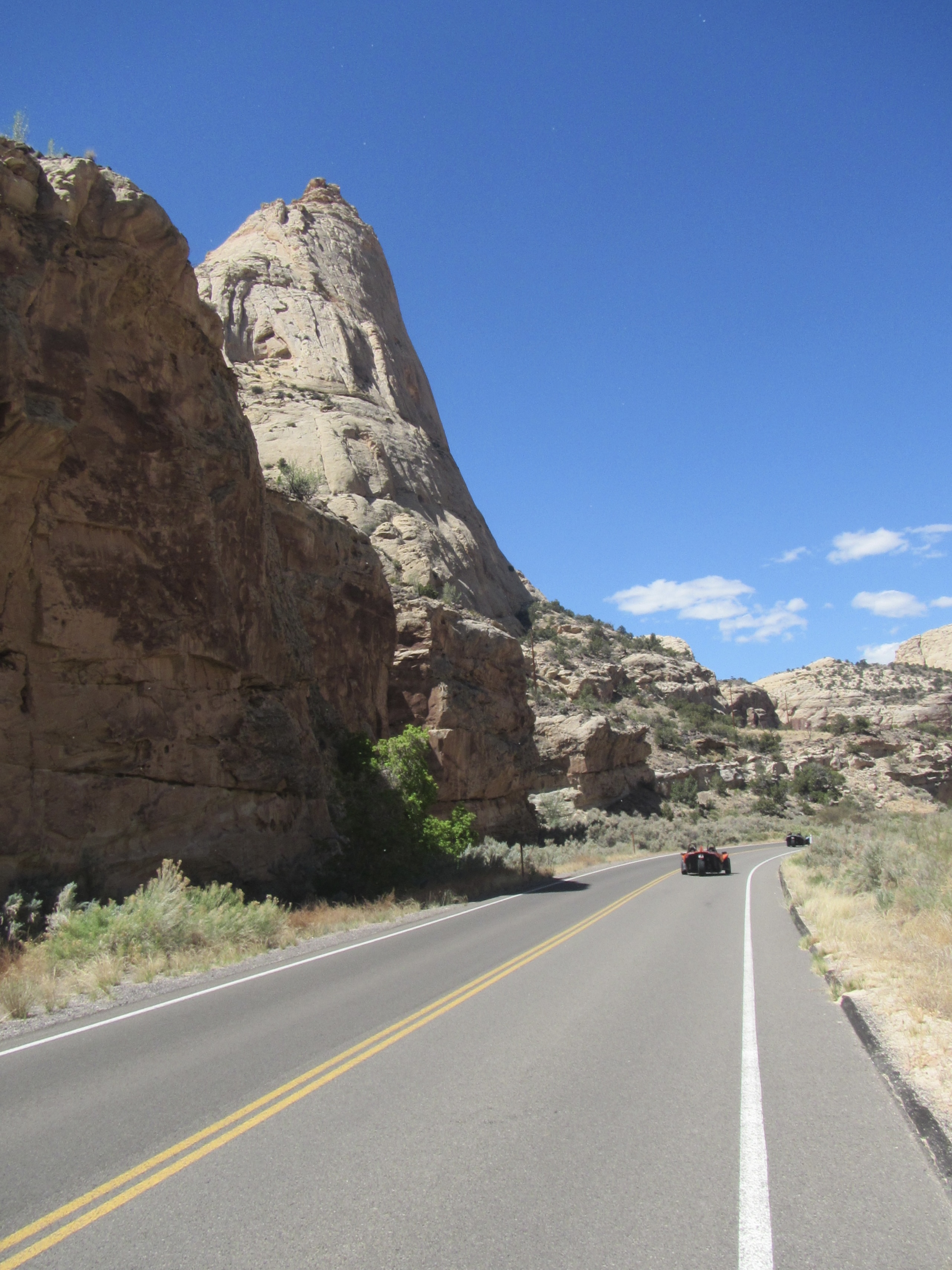
Of course, there are other attractions to motorcycles, and touring the US these last two weeks has reinforced many in my mind. On the road, there’s a camaraderie between bikers; a shared passion that’s acknowledged with nods of our helmets, or a wave of the hand. And typically, on arrival, there’s a generosity to the welcome you receive, fuelled (supercharged even) by Americans’ probing curiosity.


All this adds an extra dimension to the quality of the journey, the memories we file and the stories we share. There’s something special too, about being ‘in’ the landscape while travelling through it at speed.  Pirsig’s TV analogy seems not to stretch to a motorcycle visor ( I suspect he rode with an open face helmet) and here on the desert roads, the immensity of the place and smallness of your presence is as tangible as it is intoxicating.


I’m conscious that little of this will be new or revelatory to a hill walker or cyclist. The fellowship of mountain huts is legendary, as is the love of bicycles in, say, France. I was once riding through the Alps on a tandem when a mountain train stopped for the passengers to cheer us on; some even disembarked to offer fresh croissants. Another time, on a mountain trek, I met a blind walker who humbled me with the interest he showed in the achievements of others. 


Indeed, the physical demands of most outdoor pursuits are greater than motorcycling, lacking, as they do, an engine to boost your momentum.  Cycling, in particular, can be so draining that you close in on yourself, leaving precious little energy for admiring the view. Rock climbing and whitewater kayaking - my other lifelong passions - are not dissimilar: the attraction being less an adrenaline rush than their immediacy and intensity of focus.


Perhaps then, my newfound love of motorcycling has something to do with age, coming as it has with a lessening of strength and slowing of the reflexes. I like to think my powers of concentration are undiminished; certainly Jane would tell you I’ve not lost the ability to selectively zone out! Jokes aside, there’s probably some truth in this, though it’s not the full picture.


Since taking up the pastime, I’ve been amazed that motorcycles are not more popular with the younger generation. The vast majority of riders are male, white and likely retired. Yet for less than the price of an average electric mountain bike, you can buy a machine that will capably take you around the world.  If I were twenty years old again, I know what I’d be doing with my summers.


Thankfully, my youngest son is just as happy to humour his old man. Indeed, riding with him has become one of my greatest joys. So while I’ve loved every mile of my two-week tour of the Southwest States, I’d trade them all in a heartbeat for a single one of the trips we’ve made together in Wales. 


Luckily, I don’t have to.


Which brings me back to Robert Pirsig, whose autobiographical journey can be read on several levels: as a travelogue, a philosophical conversation, and a coming of age in his role and relationship as a father. I doubt that he travelled the same roads as me this fortnight, but it’s surely no coincidence that ‘Zen and the Art’ has long been one of my favourite books. 

Thursday, May 1, 2025

Size matters…

Travelling by motorcycle through the US this week, I’m struck by the tension between my sense of both its familiarity and difference, Unlike the twenty or so miles separating Dover from Calais there’s no language barrier here, the roads and infrastructure are not dissimilar to our own, and the food, for all its occasional oversize portions, would find a welcome home in most British pubs. I guess the climate is more extreme, but that’s increasingly so in the UK too - frankly, even Vegas felt like Blackpool on acid.

Indeed, so much of our culture is now shared that the differences between them are smaller and subtler than we perhaps like to admit. There’s a tangible lack of self-consciousness in America (even more so of deprecation or irony) that to us Brits can feel brash to the point of cringeworthy. So too with the overt displays of patriotism and religion; yesterday, on the road to Cortez, I counted over fifty US flags, several of them flying from Baptist chapels.

While that’s not something you’d see in the Cotswolds, a moment's reflection brings to mind the Union Jacks we dig out for the World Cup or Royal Weddings.  And as for Americans being arrogant,  consider the plummy accents of our upper classes and elitism engendered by public schools. Ultimately, for all our superficial contrasts, I can’t help but feel that deep down we’re more together than apart, not least in a common if incompatible faith that our respective homelands, and their associated values, music, sports… you name it… are a model for the rest of the world to follow. 

But riding through - and ‘in’ - the landscape here, I’m struck by one overwhelming difference, encapsulated in an adjective that repeats with every turn of the road. This place is vast!  And as I said today, tongue in cheek, to a delightfully welcoming gallery host I met in Durango - size matters!

We were viewing some over-scaled photo prints by David Yarrow, and thankfully, she laughed, confirming that we can share a sense of humour after all. It turned out that we also shared an interest in nature and art, and the capacity of both to inspire and connect us to something bigger than ourselves. 

Of course, all this is possible in a more intimate setting. My point is not that bigger is better. Rather, that it’s different, and at the risk of using an intentional pun, massively so!  

Scale is important - and especially in landscape and art - because, more than any other visual or spatial factor, it impacts directly on our intuitive responses. By this I mean those visceral feelings that come in the nanoseconds before thinking and categorising and verbal proxies such as beautiful, or awe-inspiring, or for that matter, vast! Taking a painterly example, it’s precisely why the abstracts of Rothko or the water lilies of Monet were rendered so large.

And following that vein, I wonder how riding here - and the physicality that involves - has shaped my first impressions after an absence of twenty years. So much of America is bigger, and yes, brasher and less apologetic, than the distances and polite understatement that sit more comfortably with our British reserve. But it’s also wonderful and immersive and - that word again - vast.  

On Tuesday this week, I rode across the Navajo First Nation territory, uninterrupted and almost entirely alone. ‘Follow the road for seventy-two miles,’ my sat-nav said, the arrow straight tarmac melting into the heat of a pale desert sunrise. As the miles clicked by, I kept thinking of Steinbeck’s Grapes of Wrath, of Zen and the Art of Motorcycle Maintenance and the violent, if ultimately redemptive, novels of Cormac McCarthy. 

That probably says more about me than it does about modern-day America. But then this is a landscape that it’s easy to get metaphorically lost in, and yet also, I sense, a good place to find yourself.  In both regards, there’s, thankfully, still much to discover. 

Friday, April 25, 2025

Chasing dreams….

It’s rare that I’d post something on this blog before its publication elsewhere, but after a three-month respite, it seems a good way to return and set up some more regular musings.  As will become clear, I’m writing this at the start of an American road trip; a long-dreamed-of adventure of sorts. The piece is my pending editorial for an alpine newsletter, but hopefully, it has wider resonance too.

I hope you enjoy it.

Chasing our dreams….

From the window of my hotel room (on the twenty-fourth floor of the putative Royal tower), I can see little more than mile after mile of low-rise development. The flat roofs of the industrial blocks below me are peppered with air conditioning units and parked SUVs.. Beyond them, the desert and the pale hint of adventure….


In a well-travelled life, few places have rendered me so intuitively uncomfortable as central Las Vegas. Seldom have I felt as out of place and conscious of mankind’s impact on the environment, let alone our propensity for frivolity and hubris. It would be easy, though rank hypocrisy on my part, to write a piece that tears a strip off its every conception.


For the truth is, I’m here out of choice, as a gateway to a landscape that’s been on my wish list since I first watched a cowboy movie. In many ways, the city is a symbol of the conflicts that fulfilling such a dream involves. I came here in a plane, was driven from the airport by a Somalian refugee, and other than avoiding Trump Tower, paid little interest to my hotel room beyond its location and price.


How we balance the urge for adventure with environmental and ethical concerns is one of the most complex and difficult choices of our times. Like many of us who love the outdoors, I try to make a difference, and indeed, to give something back when I can, but I struggle with the idea of imposing limitations. I don’t pretend to have an easy answer, and certainly won’t stand in judgement of others, least of all, on the basis that my regular visits to the Alps are somehow more worthy than the choices of those who might opt for, shall we say, less wholesome locations.  


Which is perhaps why, for all its kitsch and superficiality, transiting through Las Vegas has been such a prompt to reflection. Not least, as a powerful reminder of the immense privilege it is to explore and experience the world like no generation has before - be that for landscape, for leisure, or for that matter, playing the slots and tables in a fantasy-themed hotel… 


 P.S. Please leave comments as usual if you wish, but understand that for the next few weeks, my technology is limited and replying or counter comments may be difficult for me to achieve.

Sunday, December 22, 2024

Marine - a friend in nature

Marine - in french, a name meaning 'from the sea'.

Last Thursday I returned from France, almost three weeks later than planned, thanks to an unscheduled sojourn (two actually) in the french health care system. I left behind one gallbladder, a string of nasty infections and an experience that was both frightening and uplifting in equal parts. While its not something I'd want to repeat, there are memories of my time there that I will carry with me - and I would not want to change...

In saying this, I don't mean the treatment, which was first class and no doubt swifter than our NHS would have provided. The efficiency of the various scans, the transfer to Lyon, the endoscopy and operation were impressive, if somewhat of a blur.  To be alone in a foreign hospital, with limited language and something clearly very wrong, requires putting your trust in others and letting them get on with the job. They were, I'm delighted to say, magnificent.

But post-op recovery requires something different. For when there is action there is concentration and focus;  unlike the long days and nights, alone in a room, where one's mind wanders and spirals, plotting a course through the mental whirlpools of Charybdis and Scylla. It's at times like like these that you need not so much a doctor, as a friend.

Which is where Marine fits into this story. 

There were many nurses in the ward, all of them kind and helpful, but she was the most jolly and the one who asked the most questions — not about my pain, but about me as a person and later about our shared passion for the outdoors. It began, in broken English, with her mention of going for a ski randonee that weekend — or ski mountaineering as I said we would call it in the UK.  She'd been brought up in Bellevaux, she said, an off the tourist track village that she was delighted I knew well, nestling as it does, under the Roc d'Enfer and Pointe de Chalune. 

And from here on, we were off...  every day thereafter, talking of the mountains and what they mean and why they're so special. I mentioned that I'd once snowshoed to the remote refuge de chavanne above her village in the winter. 'So you must know Claudius', she replied' he's a legend!'  Which indeed he is, living there alone, making copious flagons of wine and welcoming walkers and skiers all year round.  

I showed her photos of our trip and she shared more her own: a gallery of peaks and cols and cloud inversions that make this corner of the haute-savoie such a wonderful place. Later she asked about my writing and kayaking and I learned she started skiing and climbing before going to school. I could go on here, but the details don't matter, except between us in authenticating our shared passion and confirming it was something deeper than the ephemeral highs of stereotypical thrill seekers.   

Of course, I'm well aware that it's easy to romanticise a supposed friendship in times of stress. Indeed, what middle aged man would not be delighted with the attention of a young and pretty nurse?  For all I know she may have forgotten our conversations already... But truly, I don't believe that's what was going on here - and even if it were, it's not relevant to my central point .

Which is that in making a mutual connection to place and nature, she intuitively grasped that this was what I most needed to recover.  And if nothing else she understood that nursing is about more than dressings and injections. Two days before I left the ward I had a relapse in confidence and it was Marine who spotted it first — and who spoke to me thereafter that day not of the physical symptoms but of the snowfall in the hills of the Chablais, and of her friend skinning that morning up the Col de Chalune.  

Don't worry, be happy... she sang, every time she came to my room... and whatever you do, don't change Mark! You're the best and most intersting patient on my sector, she said — and true or not, it made me smile again. 

So don't you change either Marine. 

Your concern and love of nature will stay with me long after my body has healed and my time in a french hospital is but a story from the past.  This matters, and so much more than we allow ourselves to think.  

Meanwhile,  I wonder if one day we might meet again?  

If we do, I hope its on the hills, with my family beside me, so they can thank you too...  Perhaps we will cross paths on slopes, or walking on the Nifflon d'en Haut, the ridge which separates your house from mine.... or, even better, at the refuge we talked about in Ubine, that's owned by Les Amis de la Nature..  

How fitting would that be? 

Sunday, December 15, 2024

Coming through and counting steps


It’s many years since I last wrote a piece on my phone - certainly more than a decade; back in the very early days of this blog.  But needs must and I have the time to kill … For I’m currently in hospital in France where I was first admitted almost two weeks now…

A short break there to speak to the nurses


In mutually broken French and English we make ourselves understood. Not that the medical details are the purpose of the post - suffice to say I have been very unwell but am recovering at pace and am in good hands.  It will be fine - all in good time. 


Meanwhile a friend wrote to say it was an excellent opportunity for people watching… I replied, that there’s nothing so foreign as a frenchman, for the Channel is, in many ways, wider than the Atlantic.  But in truth I have a private room and the best of care, and it is the medical staff that I speak to most. 


I am struck by everyone’s kindness here and its contrast to the ‘system’ which is rigorous and rules everything - though astonishingly good in its way. ( They apologised because my private ambulance to Lyon for treatment was 45 minutes late on its return). One nurse, frustrated by lack of information for me, said there’s no humanity in the hospital - she meant the processes I think. And certainly, I hope so, because she was a living example of how much there is.


In many ways I feel blessed to have fallen ill here in France, despite some bewilderment at times. A funny word to use that - blessed - for it intimates at a type of faith with which I struggle.  And yet I have often used words like prayer and even Godspeed when speaking to others recently. Perhaps there is something in that … and perhaps, even in our secular world, they have meaning that is more than mere analogy or cultural carry over.  I sense they do in fact.


Meanwhile the photo above is of a village near my house here. Needless to say it elicits many mirthful quips - and yet, it is a beautiful place.  Indeed, I am counting the days - and the steps - till I can return. 


Very soon I hope.

Monday, November 4, 2024

Autumn musings

Oscar winding up ...

At the back of my cottage is a field. It’s one of those nondescript patches of our landscape that sees little traffic other than the cutting of silage and an occasional foray from Oscar, my ever-attentive whippet. If there wasn’t a public right of way, I doubt there’d be a gate to the road.

And yet for all its isolation — or perhaps because of it — it’s not a silent or deserted place at all. If you were to walk there in twilight, you’d likely see badgers by the northern hedge, or perhaps the family of foxes that live nearby. There are rabbits too and an occasional polecat; there’s even, somewhere in the scrub, the remains of our tortoise, which escaped, never to be found again.

Often, as I write in my garden office, there are buzzards looking for a meal; kestrels too when the grass is fresh cut. Over the years I’ve seen dragonflies, woodpeckers, almost twenty different butterflies, an adder, many weasels and a stoat… The night brings owls and moths and who knows what…

I sometimes wonder if I should submit my sightings to a wildlife survey. But they are so fleeting and incomplete that instead I write blogs and essays, which I guess is a record of sorts. What’s interesting, is that there’s often as much to see from my window as there is when I go travelling.

If Oscar could talk, he’d say it’s all about paying attention – and no doubt waiting patiently too. Yesterday, as he sniffed the morning air, I glimpsed the unmistakable tail of a red kite hovering above us. When I first came here, the nests of these magnificent raptors were protected by the army; today, there are over 300 breeding pairs in Wales.

That progress should give us hope — and prompts me to muse, that perhaps my little tramped field is not so nondescript after all.

A version of this post was first published in the AAC(UK) monthly newsletter

Saturday, August 3, 2024

A Morecambe and Wise Summer

Dark clouds gathering...

As some of you know, I edit a monthly online alpine newsletter.  Here is my latest introduction, that I thought might raise a smile.  Ironically, the sun has since come out in Pembrokeshire.

---------

According to the Met Office this apparently miserable summer is not so bad after all. It would seem our lack of sunshine is merely on the drearier side of dull and well within the statistical norms for an Atlantic archipelago that sits astride the jet stream. The problem, they say, is not so much the indigo skies as our rose-tinted memories of years gone by.

If that analysis seems awry, you’ll not be alone in your thinking. For it seems we’ve evolved to recall most keenly those events that are ‘exceptional or good’. In the case of the weather, we tend to evoke – and romanticise —the heatwave summers of our youth more than we do those holidays on a windy beach. Reality, the Met Office claims, is more prosaic than our fallible memories would lead us to believe.

I was pondering this after Jane and I spent a week in the Lake District earlier this month. Most days were grizzly at best, and yet we togged up and walked round Derwentwater and through Langdale and sat in the caff with dripping cagoules and a soggy map… actually, it was a waterlogged phone, but you get the picture. 

And you know what: we had a lovely time!

So much so, that it made me wonder, if us mountain lovers have developed some sort of evolutionary advantage? We might most vividly recall our sunniest summits or perfect paths – but it isn’t going to stop us making the most of the more mundane. Indeed, here in the UK, we’d have pretty paltry tick lists if we only ventured out in the best of conditions.

None of which is to suggest we should dismiss the meteorologists. Rather, that in summers like these, we do well to remember the wisdom of perhaps our two greatest forecasters…

What was it they used to sing?

Bring me sunshine
In your smile…

Now, that really does bring back memories.

Tuesday, July 2, 2024

Joyful journeys

Ullapool,  North West Scotland

I've been away from my desk these last few weeks and I should confess it’s because I’ve been on a journey. Specifically, I’ve been motorcycling from Land’s End to John o’ Groats, following a slow and winding route that saw us pass through ten of the UK’s national parks. I went with my teenage son, making the trip extra special as we settled into a daily rhythm of a ‘dad and lad’ riding and resting together.

Back home now in Pembrokeshire I’ve been reflecting on the richness of the landscapes we passed through. From the foxgloved lanes of Cornwall to the vast and complex sea lochs of North West Scotland; the purpled moors of the Pennines to the Grey Corries of the Cairngorms… I’m reminded of how much beauty there is to find in our own small isle — and of how much I’ve missed by perhaps overly focusing on objectives abroad.

But most of all I’ve been thinking on the journey itself — not so much the miles travelled or even the vistas they revealed. Rather, of all that went before it: of how travelling so happily and easily with my son was the culmination of decades of effort and experience —not only in planning and following a route, but in navigating love and all the twist and turns that involves.

Spending these last few weeks so close together was a privilege I shall treasure. To have done so across the length and breadth of our country was but a metaphor for the variety and splendour of all that we hold most dear. And I’m more than ever aware, that despite a lifetime of travelling far and wide, the greatest joys are those closest to home.

I hope your journeys bring just as much delight.

Journey's end at  John o' Groats - save for the 750 miles to home!

Monday, June 10, 2024

A love letter to (mountain) bikes

Mountain biking in the French Alps 

I have always loved bikes. From my first junior step through to my latest electrically charged steed, they’ve given me more joy than any other mechanical invention I can think of. In almost sixty years of pedalling, I’ve ridden (literally) the length and breadth of Britain, climbed countless passes in the Alps and once traversed the Pyrenees on a tandem. Together with the friends they’ve brought me, bikes are one of the greatest joys of my life.

So it was perhaps inevitable that I’d be an early adopter of the trend to 'all terrain' cycles.

In the mid-eighties, before many folk had 'proper' mountain bikes, I co-organised an ‘off road’ weekend in the Lake District. We had no idea how many riders would come or even what contraptions they’d bring. In the event, two dozen of us ground our way up High Street on a motley collection of bone-shakers, descending with squealing brakes, several blow outs and one broken collar bone. By the next morning I’d say about half were converts; the remainder saying it would never catch on!

I wonder what those doubters would think of popularity of mountain biking today? In the Alps, it’s become the summer equivalent of skiing, attracting hundreds of thousands to the mountains every year. A vital part of the tourism economy, resorts compete to host events, promote their trails and provide a network of lifts that mean some riders don’t even pedal uphill!

The alpine club, for which I edit a monthly newsletter, embraced mountain biking as late as 2017. I suspect that’s a reflection of the age and interest profile of members; but I wonder if there was also a certain reluctance to see fat tyred bikes as quite the right thing in the hills? I can understand if that was the case, for despite my love of cycling, I too am often frustrated by an irresponsible minority of riders.

But then I like to remind myself that all the mountain activities I love are relative newcomers to the landscape. My house in France was built long before the Matterhorn was climbed, before downhill skiing was invented or anyone thought of descending rapids in a kayak! It seems to me that adapting to change is as much a part of the outdoor experience as the putative permanence of the views.

And as for electric assistance – well that’s just brilliant!

--------

This post is a very lightly ammended version of my editorial, published by AAC (UK) e-newsletter in June 20024

Friday, May 3, 2024

Digital dilemmas


On the Tour des Fiz last summer —
I didn't once look at a map; all navigation by phone.

James, from the Apple Store, was young, personable, and clearly capable in what he was doing… and yet his breezy confidence was equally terrifying. ‘Just leave it with me,’ he said, ‘if you come back in forty minutes, it’ll all done.’ I wanted to ask, but what about…, and can you explain…. and how does … but I didn’t have the courage.

Instead, I wandered around the shop-cum-gallery, trying to ease the pit in my stomach. What would happen if he lost my data? Would my banking apps still work… and do they back up my photos first…? Honestly, I reckon buying a new phone must rank with house buying and divorce as one of life’s most stressful experiences.

Okay, I exaggerate a little. But it’s significant how much of our life we now hold, literally, in the palm of our hands. In my case, my phone is my letterbox, my bank, my photo album, my document store, my daily newspaper… it’s become an essential connection to the everyday world, as much as to my family and friends.

And yet as I pondered the walls of screens in the store, I noticed how many of them depicted mountains and wilderness. From the Alps to the Arctic, they promised an aspirational paradise of travel and adventure - the very places we visit to escape the trappings of daily life. I doubt if any of the idealised landscapes on those screensavers have a mobile signal or a charging point nearby.

Sometimes, I wonder if I ought to take off with no more than a map and compass – just as I did for decades before succumbing to the digital dark side. For the truth is, the things we truly treasure are not held on a microchip or lodged in the cloud – they are the result of our physical efforts, our successes and failures our love and our laughter…

Or as James from the Apple Store might put it, 'our analogue experience!’

Meanwhile, if you're wondering about my new iPhone 15 Pro Max - everything transferred without a hitch.  

Amen to that!


Wednesday, April 3, 2024

Mountain memories

Lake District 2020 -more than fifty years after my first visit 

Earlier this year my mum took the difficult decision to move to a care home. She’s increasingly frail and immobile, but still takes joy from simple pleasures such as sunshine through her window and the accompanying dawn chorus.

Like many very elderly people her memory isn’t great and large parts of her past are now at best a blur. Sometimes when I visit, we sing together, for it’s well known that music, and particularly the association of lyrics with melody can help. But last week it was a conversation about mountains that triggered a surprising recollection.

We were talking about a childhood holiday to the Lakes and I mentioned how we’d climbed Latrigg Fell on the edge of Keswick; it was my first mountain walk, I said. ‘But oh, you did more than that’ she interjected, ‘we went up Cat Bells and Skiddaw and Haystacks too.’ And she went on to mention Blencathra and Red Pike and the Old Man of Coniston, describing the routes we’d taken and even the weather.

How strange – and yet how wonderful – that when so much of her past is lost in mist, she could remember these hills and wild places with such clarity. It made me wonder if, through the effort of climbing, our footsteps embed themselves more deeply in the pathways of our minds. As if they somehow create a sort of memory map that’s as hard wired to our brains as the circuit board is to the computer I’m typing this piece on.

That’s probably cod psychology but I’m not sure it really matters – what’s important is that it feels that way. If I’m lucky enough to last as long as my mum, I pray my own mountain memories remain as clear as hers. For in truth, they are high among the most precious moments of my life.

Here's to making memories that last.

(This post was first published in the AAC UK monthly e-newsletter)